

There is a specific sound that makes a Chief Officer nervous. It isn’t the wind whistling through the rigging or the slap of a halyard against the mast; it’s the angry, high-pitched hornet buzz of a drone hovering just inches away from the freshly varnished capping rail.
We have all seen the result of that buzz: those breathtaking shots on Instagram where the vessel cuts through turquoise water, the wake fanning out like a bridal train, capturing a sense of scale that deck-level photos simply cannot achieve.
It is the kind of footage that sells charters and defines a yacht’s brand, especially when a skilled drone photographer is behind the controls, ensuring each photo is both stunning and impactful.
But for those of us actually working on deck, we know that getting that perfect shot isn’t just about launching a gadget and hoping for the best. Drone activities are carefully launched as part of planned superyacht routines, requiring coordination and precision.
It requires a blend of artistic vision, technical piloting skills, and a rigorous, almost military adherence to safety protocols. The complexities of flying drones in maritime environments, where wind, salt spray, and moving decks add to the challenge, demand experience and adaptability.
At Certified Training, we constantly remind our deckhands and STCW students that the modern maritime industry demands more than just traditional seamanship; it demands technical proficiency. Integrating drones is no longer a novelty; it is fast becoming a standard operational requirement.
Whether we are filming a promotional reel for a charter broker or inspecting the mast rigging for wear and tear, the stakes are high. We are dealing with expensive equipment flying over even more expensive assets, often in unpredictable maritime environments.
Documenting scenic anchorages or remote bays often means capturing the untouched nature and natural beauty that is the hallmark of these locations. In this guide, we’re breaking down everything we need to know to master the art and science of drone operations at sea, from capturing the perfect photo to elevating marketing and guest experiences.
What Are Drone Operations and Aerial Photography on Superyachts?
When we talk about drone operations in this sector, we are moving far beyond the realm of casual hobby flying. On a superyacht, a drone is a precision tool integrated into the vessel’s daily rhythm. It serves multiple departments, from the deck team to the marketing office.
Aerial photography here encompasses high-resolution stills for listing sites, cinematic video reels for social media, and drone video captured with high-resolution cameras capable of streaming 6K footage in real time.
Drone video plays a crucial role not only in marketing and showcasing the vessel but also in security, as it can be used for live monitoring and may pose privacy risks if not properly managed.
It also includes live monitoring for security or operational awareness during complex maneuvers. We aren’t just taking selfies; we are creating assets that define the vessel’s brand.
Common scenarios we encounter include capturing guest arrivals by tender, something our RYA Tender Operator students know is a high-pressure moment, or documenting scenic anchorages in remote bays.
We also use these operations for “lifestyle” content, showing the crew in action or the chef plating a meal on the sundeck. For those seeking a more immersive experience, guided tours for drone photography on superyachts are available, offering expertly organized trips with local knowledge and personalized attention.
Every flight has a specific mission profile and a desired outcome.
Why Are Drones Used on Superyachts for Aerial Photography?
The primary driver for drone usage is perspective; nothing conveys the grandeur of a superyacht like an aerial view. From the waterline, a 60-meter yacht looks big, but from the air, its design lines and deck spaces truly shine. We can showcase the jacuzzi, the beach club, and the sun pads all in a single frame.
This capability translates directly into marketing and charter value. Listings with high-quality aerial video and a well-composed photo generate significantly more engagement than those without. A striking photo can capture the essence of the yacht and make a listing stand out. We are selling a dream, and that dream looks best from 50 meters up, surrounded by the ocean.
Beyond marketing, there is the guest experience to consider. We can offer charter guests a professionally edited drone video of their trip, providing a keepsake that is far superior to iPhone snaps. When done with consent, this adds a layer of personalized luxury service that guests rave about.
How Do Drone Operations Work on a Moving Superyacht?
Flying from a stationary platform is easy; flying drones from a moving superyacht is an entirely different beast, presenting unique complexities and challenges.
The most critical phase is the launch and recovery, which requires a specific set of skills. We must account for the vessel’s speed, the wind over the deck, and the turbulence caused by the superstructure.
For launch, crew and equipment are strategically deployed to ensure safe operations. Launching usually requires a dedicated “spotter” to assist the pilot, ensuring the flight path is clear of antennas and rigging.
We need a clear deck space, usually the helipad or a cleared sun deck, away from guests. Wind checks are vital, as the apparent wind on a moving boat can be much stronger than the true wind.
Recovery is where most accidents happen. We cannot rely on the “Return to Home” (RTH) button because the “home” point recorded at takeoff is now kilometers behind us. We often have to practice “dynamic home point” updates or, more commonly, manual landings.
Catching the drone by hand is a common, albeit risky, technique used by experienced pilots to avoid deck skids.
Understanding Drone Threats on Superyachts
In recent years, the world of superyachts has seen a dramatic rise in drone activity, bringing both opportunities for stunning aerial footage and new security challenges.
As drone technology becomes more accessible and sophisticated, superyacht owners and their crew face a growing threat from drones operating near their vessels, whether moored in the French Riviera, anchored in open water, or cruising between exclusive ports.
The risks posed by drones are multifaceted. On one hand, drones are increasingly used to capture breathtaking drone photography and video, showcasing super yachts in all their glory. However, this same technology can be exploited for less benign purposes.
Drone threats now include unauthorized surveillance, data collection, and even the potential for sabotage or physical attacks. The presence of drones near a superyacht can compromise the safety, privacy, and security of owners, guests, and crew, making robust protection measures essential.
Superyacht owners, especially those with many clients or high-profile guests, are acutely aware of these risks. The growing threat of drones has led to a surge in demand for advanced drone detection and defence systems.
One of the most effective solutions on the market is the NIDAR system, which leverages cutting-edge sensors and radar to detect, track, and assess drone activity in the vicinity of a vessel.
By providing real-time alerts and a comprehensive overview of the airspace around the yacht, systems like NIDAR empower owners and security teams to respond swiftly to any potential threat.
But the challenge is not limited to malicious intent. The popularity of drone photography means that even well-meaning drone pilots can inadvertently invade the privacy of superyacht owners and their guests.
Unauthorized photographs or videos can be captured and shared without consent, turning a moment of relaxation on deck into a potential privacy breach. This is particularly concerning in high-traffic areas like the French Riviera, where the presence of drones is almost constant during peak season.
To defend against these risks, superyacht owners must take a proactive approach. Investing in professional-grade drone detection systems is a crucial first step, but technology alone is not enough.
Crew members need to be trained to recognize the signs of drone activity, understand the capabilities and limitations of detection equipment, and know how to respond in the event of a drone threat.
Working with security teams who have expertise in countering drone threats ensures that the vessel is protected from both the air and the surface.
A comprehensive drone protection strategy should also account for legitimate drone operations, such as authorized aerial photography or inspections.
Clear protocols must be established to distinguish between approved and unauthorized drone flights, ensuring that only trusted drone photographers or operators are permitted to capture footage of the yacht.
This not only safeguards privacy but also maintains the professional image of the vessel.
Ultimately, the presence of drones in the superyacht environment is a double-edged sword. While they offer unparalleled opportunities for capturing stunning aerial footage and enhancing marketing efforts, they also introduce new risks that cannot be ignored.
By staying vigilant, investing in advanced detection systems like NIDAR, and fostering a culture of security awareness among crew and security teams, superyacht owners can continue to sail with confidence, knowing that their vessels, guests, and privacy are protected against the evolving threat of drones.
What Legal Rules Apply to Drone Operations on Superyachts?
One of the biggest misconceptions we face, and one we correct frequently in our training discussions, is the idea that “international waters” means no rules apply. In reality, we are always under the jurisdiction of the Flag State or the coastal state we are navigating.
Rules vary wildly from the liberal regulations in some Caribbean nations to strict bans in places like Antarctica or national parks. Additionally, drone operations are often restricted or regulated in and around a port, as ports have specific security protocols and heightened concerns about drone activity.
Key compliance areas we must track include registration of the drone and the pilot. Many countries require a specific heavy-lift permit for drones over a certain weight. We also have to respect maximum altitude limits, which are usually around 120 meters (400 feet).
Distinguishing between recreational and commercial use is critical. If the footage is for a charter brochure, it is commercial work, and local aviation authorities often require specific permits. We always recommend checking with local yacht agents before unpacking the drone case.
Do Crew Members Need Certification to Fly Drones on Superyachts?
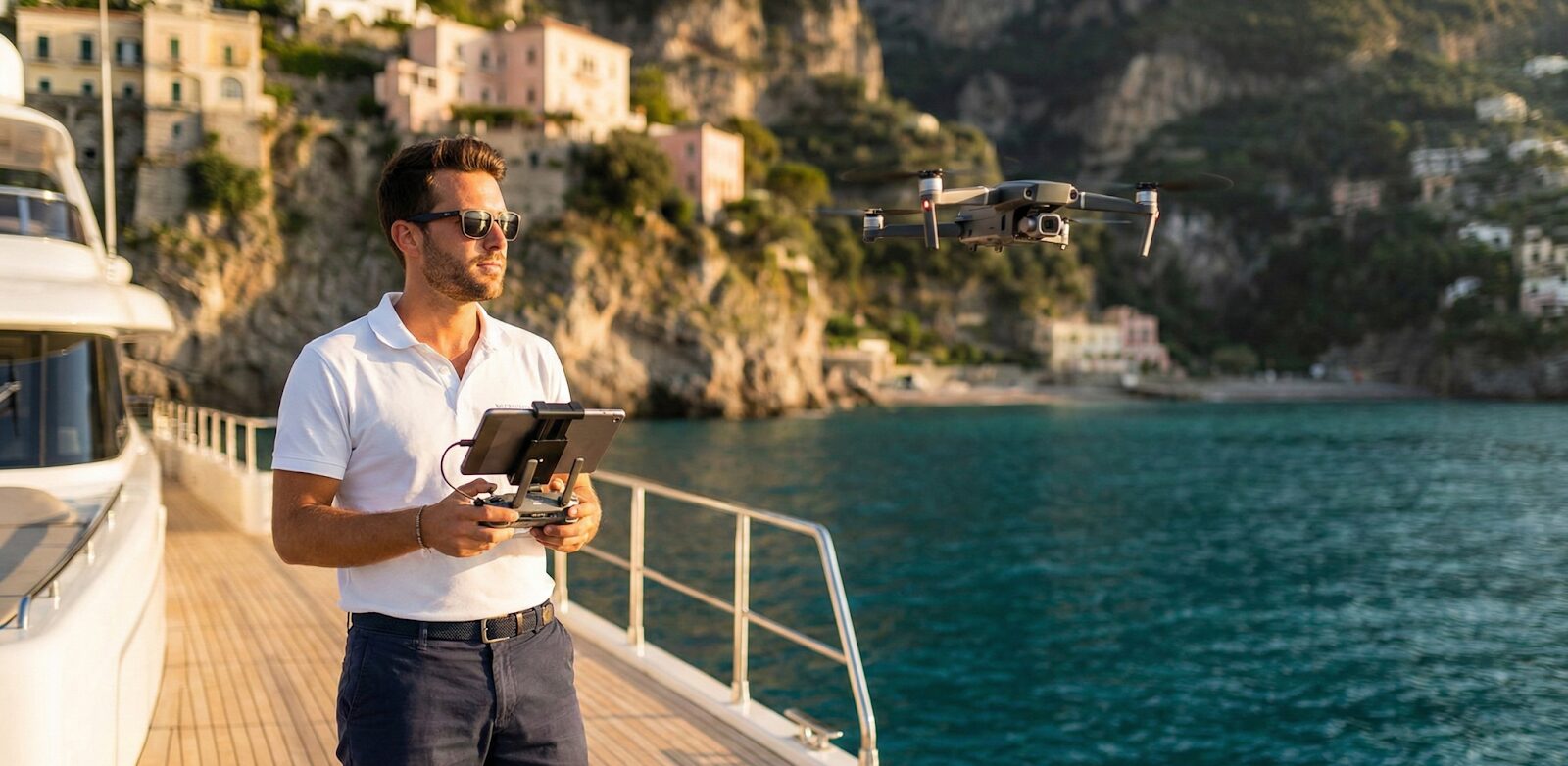
The short answer is: increasingly, yes. While a casual flight might not trigger a license check, professional commercial filming usually demands it. Having a certified pilot on board protects the vessel, the owner, and the crew from liability.
At Certified Training, we see a shift where captains prefer hiring deckhands who already hold a drone license alongside their Powerboat Level 2 or Deckhand qualifications. It demonstrates a level of professionalism and understanding of airspace regulations. A licensed operator knows how to read sectional charts and understands NOTAMs (Notices to Airmen).
Yacht owners are also increasingly expecting crew members to have drone operation certifications, reflecting their heightened focus on security, privacy, and professional standards.
Practical expectations on board now include having a designated “Drone Officer” or responsible crew member. This person maintains the flight logs, manages the batteries, and conducts safety briefings. It connects drone responsibilities to the wider culture of safety management systems (SMS) that govern superyachts.
What Safety Risks Are Involved with Drone Use on Superyachts?
The maritime environment is hostile to electronics. We face risks that land-based pilots never have to consider, starting with the salt spray. Salt corrosion can destroy motors and sensors invisibly, leading to mid-air failure.
Physical hazards on the yacht itself are numerous. We have to navigate around whip antennas, radar scanners, and rigging that can be nearly invisible on a drone’s camera feed. High-frequency interference from the yacht’s radar or VSAT systems can also cause signal loss, sending the drone into an uncontrolled drift.
Then there are the environmental factors like high winds and sudden squalls. A drone fighting a headwind to return to the boat will drain its battery much faster than expected.
For this reason, it is crucial to use drones with sufficient power to handle strong winds and adverse conditions, ensuring reliable performance and safe recovery. We must always plan for a “point of no return” regarding battery life.
How Is Guest Privacy Protected During Aerial Drone Photography?
Privacy is the ultimate luxury on a superyacht, and drones can threaten that if not managed correctly. We must establish clear boundaries about who can be filmed and when. Guests often want their privacy protected, and we must ensure no footage of them in swimwear ends up on the internet without explicit permission.
To further protect privacy, warning systems that detect unauthorized drone activity are essential. These systems provide early alerts to crew and guests, allowing for timely responses and risk mitigation.
We also have to respect the privacy of third parties. Flying over neighboring yachts in an anchorage is a major breach of etiquette and often illegal. We should never film into the private decks of other vessels or hover over nearby private beaches.
Content handling is the final piece of the privacy puzzle. We need secure storage for footage, ensuring memory cards aren’t left lying around the crew mess. Sharing permissions must be strictly controlled by the captain or the management company.
What Equipment Is Best for Aerial Photography on Superyachts?
When selecting gear, we prioritize reliability and wind resistance over pure camera specs. A drone that can handle 25 knots of wind is more valuable to us than one with 8K resolution but weak motors. Stabilization is key, as the boat is always rocking.
We look for drones with robust transmission systems that can cut through the RF interference on a yacht. The range of both control and video transmission is critical, as it determines how far we can safely operate and monitor the drone from the vessel.
Features like obstacle avoidance are helpful, but they can be confused by water and reflective surfaces, so we don’t rely on them blindly.
Essential Gear for Marine Drone Ops:
- ND Filters: Essential for cutting glare off the water and maintaining cinematic shutter speeds.
- Polarizing Filters: These help us see through the water surface to capture reefs or marine life.
- Waterproof Landing Pad: Protects the drone from wet teak or anti-skid surfaces.
- CorrosionX (or similar): For treating contacts and screws against salt air.
- High-nit screens: Standard phone screens are invisible in bright maritime sun; we need high-brightness controllers.
- Underwater cameras and housings: For capturing scenes and activities below the surface, complementing aerial footage.
How Can Drones Support Superyacht Marketing and Operations?
For marketing, the applications are obvious: hero shots and destination reels. We use drones to create “lifestyle” edits that sell the experience of the charter, not just the hardware.
Destination reels that show the yacht anchored near a famous landmark are gold for social media. Capturing the highlights of a cruise with aerial footage and photos is especially valuable for promotional purposes.
On the operational side, drones are becoming inspection tools. We can fly a drone to inspect the masthead light or check the condition of the paint on the radar arch without sending a crew member up in a harness.
This saves time and reduces the risk of working aloft, a core safety principle we emphasize in our STCW training.
We also use drones for documentation during refit periods. Flying over the vessel while it is on the hard stand allows us to track paint progress or hull condition. In the unfortunate event of a collision or grounding, a well-timed photo or aerial footage provides undeniable evidence for insurance claims or operational records.
What Best Practices Ensure Safe and Professional Drone Operations?
Preparation is everything. We never launch without a pre-flight briefing that includes the pilot, the spotter, and the Officer of the Watch (OOW).
The bridge needs to know we are airborne so they don’t engage radar scanners that could fry the drone’s compass. Crew and equipment are strategically deployed to ensure all safety protocols are followed before every flight.
Our Pre-Flight Checklist:
- Airspace Check: Are we in a restricted zone?
- Weather Check: Wind speed, direction, and gusts.
- Vessel Status: Is the boat moving? Are stabilizers active?
- Battery Health: Are all cells balanced and fully charged?
- Home Point: Is it set to “Dynamic” or the controller’s location, not the takeoff point?
In-flight discipline is about maintaining Line of Sight (VLOS). We never fly behind the vessel or behind obstructions where the signal could be cut. We also keep a safe distance from guests. Drones are noisy and can ruin a relaxing afternoon if flown too close.
Post-flight care is just as important. We wipe down the drone with a damp cloth to remove salt spray immediately. We discharge batteries to storage voltage if they won’t be used for a few days to preserve their life.
What Is the Future of Drone Operations on Superyachts?
The technology is evolving rapidly. We are looking forward to drones with better waterproofing, allowing for recovery directly from the water. Improved “Return to Boat” logic that tracks the vessel’s AIS signal is also on the horizon.
Future advancements are expected to bring increased power and performance to drone technology, enabling even more impressive aerial cinematography and operational capabilities.
We also anticipate tighter regulations. As the skies above popular anchorages like St. Tropez or Monaco get crowded, we expect to see stricter enforcement and perhaps mandatory transponders on all marine drones. This will professionalize the sector even further.
Ultimately, the demand for crew who can double as skilled aerial cinematographers will only grow. It is a skill set that adds immense value to the boat. We are moving toward a future where a drone is as standard on a superyacht bridge as a pair of binoculars.
FAQs
What are drone operations on superyachts used for?
They are primarily used for marketing photography, capturing drone video for guest entertainment and promotional purposes, security monitoring, and technical inspections of hard-to-reach areas like masts.
Are drones allowed to fly around superyachts?
Generally, yes, but it depends on the local laws of the country the yacht is visiting. Some ports and national parks strictly ban them.
Do superyacht crew need a licence to operate drones?
For commercial work (which includes charter marketing), a license is almost always required. It is also a best practice for insurance purposes and looks excellent on a CV alongside your STCW and Deckhand certifications.
What safety precautions are needed for aerial photography at sea?
You need a spotter, a clear deck area, awareness of the boat’s radar interference, and a plan for landing on a moving target.
How do drone regulations differ between countries and waters?
Every country has its own aviation authority with different altitude limits and no-fly zones. “International waters” rules don’t apply once you enter a nation’s territorial seas.
Can drones be used while a superyacht is moving?
Yes, but it requires advanced piloting skills. The pilot must account for the relative wind and the fact that the landing spot is moving away from the drone.
How is guest privacy protected during drone filming?
Crew must obtain consent before filming. Filming implies a responsibility to secure the data and not share it publicly without clear permission.
What type of drone is best for superyacht aerial photography?
Drones with high wind resistance, reliable transmission systems, excellent cameras (like the DJI Mavic 3 Pro or Inspire series), and an extended range are industry standards. The range is especially important for superyacht drone operations, as it determines how far the drone can travel from the vessel while maintaining a stable connection and high-quality aerial photography.
Conclusion: Elevating Your Superyacht Career
In the competitive world of superyachting, the difference between a good crew member and an indispensable one often comes down to the extra skills they bring to the table. While a drone license won’t replace the need for solid seamanship or a strong work ethic, it is becoming a powerful differentiator.
At Certified Training, our mission is to prepare you for the reality of the industry. We build the foundation with our STCW, Deckhand, and Steward/ess courses, ensuring you are safe, compliant, and competent.
But we also encourage our students to look ahead. Mastering modern tools like drones is just another way to show a captain that you are ready for the responsibilities of a modern vessel.
So, whether you are just starting your journey with our Introduction to Yachting course or you are an experienced deckhand looking to upskill, remember that the industry rewards those who can adapt. Get certified, stay safe, and keep your eyes on the horizon, both from the deck and from the sky.