

There is a specific kind of confidence that comes from standing in the heart of a 50-meter superyacht, surrounded by millions of dollars of precision machinery, and knowing exactly how to keep it humming.
While most of the world sees only the sleek lines and white hulls of luxury vessels, we know that the true soul of the ship lives below the waterline in the engine room.
For those looking to break into the industry or elevate their status on board, the bridge between being “just crew” and becoming a vital technical asset is built on a single qualification.
We often tell our students that the maritime world rewards those who can solve problems, and there is no problem more pressing than a mechanical failure in the middle of the Atlantic.
The MCA Approved Engine Course (AEC) is the gold standard for entry-level marine engineering, designed to turn curiosity into competence.
Because there is virtually no commercial yachting work within Cape Town itself, this course acts as your launchpad, providing the international credentials needed to secure high-paying roles in the Mediterranean, the Caribbean, and beyond.
In this comprehensive guide, we will break down everything you need to know about the AEC modules, the career pathways they open, and why this is the smartest investment you can make for your future overseas.
Whether you are a “green” deckhand looking to double your value or an aspiring engineer ready to climb the ranks, we are here to show you the way. Let’s dive into the nuts and bolts of the AEC with the expertise of the team at Certified Training.
What is the MCA Approved Engine Course (AEC) and why is it important?
The MCA Approved Engine Course (AEC) is the primary entry-level qualification for anyone looking to work professionally in the engineering department of a yacht. This 5-day entry-level certification is designed for marine engineers, deckhands, and skippers working on commercial vessels under 24m or superyachts.
We view this course as the essential “Level 1” for the maritime technical world, recognized by the Maritime and Coastguard Agency (MCA). It provides a baseline of safety and mechanical understanding that is required by law on many vessels.
The AEC is divided into two modules: Approved Engine Course 1 (AEC1) and Approved Engine Course 2 (AEC2). Approved Engine Course 1 (AEC1) is an MCA-approved, non-STCW certification that delivers foundational theoretical and practical training for marine engine personnel, focusing on small vessel engineering and maintenance skills.
Approved Engine Course 2 (AEC2) is a mandatory, advanced training module for aspiring Small Vessel Second Engineer Officers, building on the foundational knowledge of AEC1 with a practical, hands-on approach.
Whether you’re aiming to become a yacht engineer or simply want to broaden your technical skills, this training course serves as the perfect launchpad.
The Entry-Level Standard
The AEC is the primary qualification for those looking to work in the engine room of yachts over 24m or as a lead engineer on smaller vessels.
For vessels over 24 meters, the engine room is a complex engineering environment that requires more than just basic common sense, emphasizing the importance of understanding safe systems of work and compliance with management requirements in engineering operations.
We have designed our training as part of a suite of engineering courses to ensure you meet these rigorous international standards before you head overseas.
Students will learn the fundamentals of marine diesel engines, including basic engine operations, troubleshooting, and maintenance specific to vessels. Approved Engine Course 1 (AEC 1) is a prerequisite for obtaining a Marine Engine Operators License and is issued by MCA-approved training providers.
Career Versatility
One of the most significant advantages of this qualification is the “dual-role” capability it offers. We find that many deckhands take this course to become “dual-role” crew, significantly increasing their hireability and value to the boat. By being able to assist on deck and maintain the engines, you become a versatile asset that captains are eager to hire for international crossings.
Regulatory Compliance
We must discuss how this course fits into the Maritime and Coastguard Agency (MCA) “Small Vessel” (SV) structure. This structure oversees engineering ranks on yachts, tugs, and workboats, ensuring all crew meet legal safety requirements. The course ensures understanding of legislative and management requirements and prepares students for safe engineering operations in line with industry standards.
Having an MCA-approved certificate ensures you are fully compliant with global maritime laws, making you eligible for professional roles anywhere in the world. Upon completion, students will be able to demonstrate knowledge of these requirements within an engineering environment.
What are the differences between AEC 1 and AEC 2?
As the industry has evolved, the AEC has been split into two distinct modules to provide a more thorough education. We believe this split is beneficial because it allows students to master the theory before diving into complex practical applications. Understanding the AEC 1 vs AEC 2 differences is crucial for planning your training timeline and budget.
AEC 1 (The Theoretical Core)
We begin by discussing the focus of the Approved Engine Course 1 (AEC 1) on basic compression ignition (diesel) engine theory and system operations. This module is the starting point, where we explore the “why” behind the machinery and the fundamental cycles that keep a ship moving.
AEC 1 provides basic theoretical knowledge essential for safety, maintenance, and operational competence in marine engineering, particularly for small vessel operations.
The course emphasizes understanding the combustion process and the operation of compression ignition engines, ensuring students grasp how air and fuel interact to produce energy efficiently.
The MCA Approved Engine Course (AEC 1) includes a minimum of 35 hours of training, which encompasses both theoretical knowledge and practical hands-on experience with marine diesel engines and their systems.
The AEC 1 syllabus includes ten learning outcomes covering essential knowledge areas such as the operation of diesel engines, fuel systems, cooling systems, and safety practices related to marine engineering.
Additionally, the course covers essential topics like 2-stroke and 4-stroke engine theory, electrical systems, and marine pollution regulations, ensuring competency.
The AEC 1 course requires a minimum of 35 contact hours, including both theoretical instruction and practical training, and must be completed within a structured training program approved by the MCA.
It is designed to take someone with zero mechanical background and give them a solid, workable understanding of marine systems.
AEC 2 (The Practical Extension)
Next, we explain how the Approved Engine Course 2 (AEC 2) adds hands-on maintenance, refrigeration, and hydraulic systems to the curriculum. AEC a mandatory, advanced training module for aspiring Small Vessel Second Engineer Officers, serving as a continuation of foundational knowledge.
The AEC 2 course consists of a 50% split between theory and practical application, ensuring students gain hands-on experience in safe engineering practices and the operation of various engineering systems.
While AEC 1 gets you started, AEC 2 is where the hands-on mastery truly begins, with a focus on achieving key training objectives such as the ‘basic maintenance outcome’ and ‘basic hydraulic systems outcome.’
We view AEC 2 as the “finishing school” that gives you the confidence to actually pick up the tools and perform service tasks on board. Additionally, AEC 2 builds on the basics to provide the advanced technical knowledge required for Small Vessel second engineer certificates.
Progression Requirements
We want to clarify that AEC 1 is a prerequisite for AEC 2 and how they combine to provide a complete foundation. You cannot skip the basics, as the knowledge built in the first week is essential for the practical work in the second. Together, they create a robust portfolio that proves your technical competence to yacht management companies worldwide.
What topics are covered in the AEC 1 syllabus?
The AEC 1 syllabus is designed to be intensive but accessible to those with a Grade 6-8 reading level. We focus on clear, direct instruction that translates well to the noisy environment of a real engine room.
The goal is to demystify the diesel engine and make it approachable for every student, ensuring that the syllabus enables students to demonstrate knowledge of all covered topics.
Engine Cycles and Systems
We detail the study of 2-stroke and 4-stroke cycles, as well as the operation of the fuel system, cooling system, and lubrication system. You will learn how these systems work in harmony to produce power and keep the vessel moving through the water.
We break these systems down into simple, manageable components so you can visualize the flow of energy through the machine.
Students will also be taught basic fault-finding techniques for the fuel system, cooling system, and other key engineering systems to ensure safe and efficient operation.
Electrical and Power Systems
A modern yacht is a floating power plant, so we mention the introduction to basic marine electrical circuits and power take-off (PTO). We cover the essentials of how electricity is generated and distributed on board, focusing on the electrical distribution system and engine electrical systems that power everything from the lights to the navigation systems.
Understanding the basics of batteries, engine electrical systems, and circuit breakers is vital for any crew member.
Safety and Pollution
Safety is the lens through which we view every part of the syllabus, covering engine room safety protocols and emphasizing safe working practices such as risk assessments, fire prevention, confined space entry, and firefighting techniques.
We also detail the legalities of preventing marine pollution (MARPOL), highlighting the importance of understanding the sewage system onboard as a key component in pollution prevention.
We want our students to be safe operators who protect both the crew and the delicate marine environment in which they will be working overseas.
What advanced skills will you learn in the AEC 2 module?
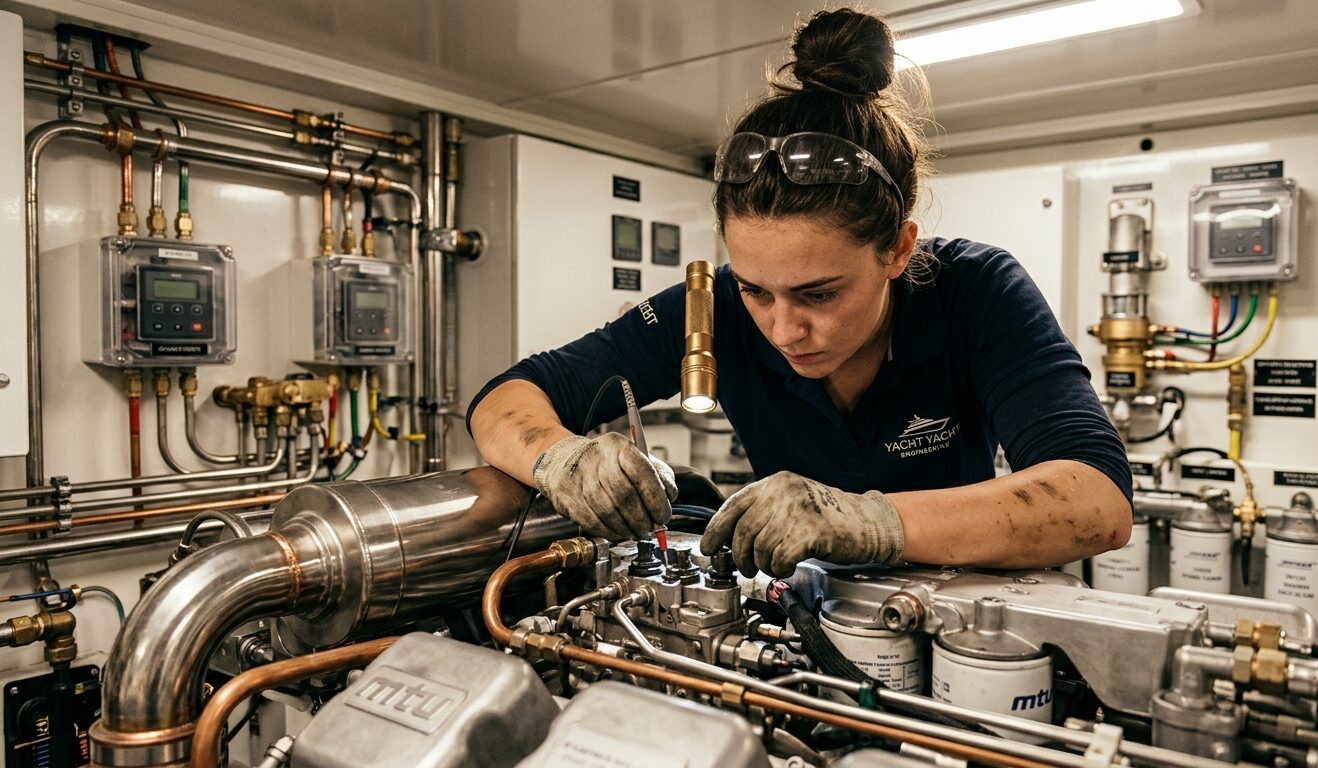
Once you have the theory under your belt, AEC 2 takes the training to the next level. This module is all about the practical skills and advantages that make you an indispensable member of the crew. We shift the focus from “how it works” to “how to keep it working” in a demanding offshore environment. Completion of the AEC 2 module requires passing a final written assessment.
Component Overhauling
We explain the practical aspects of stripping and overhauling engine components, including hull fittings. You will learn the proper use of specialized tools and the correct sequence for dismantling and reassembling parts. This hands-on experience is what captains are looking for when they hire a junior engineer for a global crossing.
Ancillary Systems
A yacht is much more than just an engine; it is a complex web of ancillary systems. We detail the introduction to refrigeration, air conditioning, steering gear maintenance, and the fresh water system onboard.
Being the person who can fix the AC, the fridge, or ensure the fresh water system is operating safely and efficiently when it goes down in the tropics will make you the most popular person on the boat.
Hydraulics and Maintenance
Many of the largest systems on a yacht, from the anchor winch to the swim platform, are powered by hydraulics.
We discuss the focus on hydraulic deck machinery and creating structured maintenance schedules, emphasizing the importance of safe systems of work to ensure safety and compliance during all procedures.
Our training is designed to help you achieve a basic maintenance outcome, equipping you with the fundamental skills needed to maintain system functionality and safety in an engineering environment. We teach you to be proactive rather than reactive, preventing breakdowns before they happen.
What are the prerequisites for the MCA Approved Engine Course?
One of the best things about the AEC is its accessibility. While some may compare it to a diesel mechanics course, the AEC is specifically tailored to marine engines and systems, focusing on practical skills and knowledge relevant to the maritime industry rather than general diesel engine repair.
We often find that some of our best students are those who have never held a wrench but have a strong desire to learn a technical trade. However, there are a few basic ground rules we need to establish before you enroll.
Sea Service Requirements
We want to clarify that there is no mandatory sea time required to start AEC 1, making it ideal for entry-level “green” crew. This is a massive advantage for those looking to get their first yachting course under their belt before flying overseas. It allows you to land your first job with a competitive edge on your CV.
Age and Medical Fitness
To participate in yacht training for the AEC, we must state the minimum age requirement of 18. We also provide the recommendation of having a valid ENG1 or equivalent medical certificate. While not strictly required for the course itself, you cannot work on a professional yacht without one, so it is best to ensure you are medically fit early on.
Technical Aptitude
While no prior engineering experience is needed, we note that a basic mechanical interest is beneficial. If you enjoy taking things apart and figuring out how they work, you will thrive in this environment.
We provide all the specialized instruction you need, but a “can-do” attitude is the most important tool you can bring to the classroom.
How does completing the AEC boost your superyacht career?
We don’t just teach you how to fix engines; we teach you how to build a career. The AEC is a transformative qualification that changes how you are perceived by the international industry. It is the first major milestone in the MCA engineering officer of the watch pathway.
This qualification applies to a wide range of vessel types, including fishing vessels, government patrol vessels, and oceanographic research vessels, highlighting its versatility across the maritime sector.
Path to Chief Engineer
For those with long-term ambitions, we explain how the AEC is the first milestone toward the “Second Engineer” and “Chief Engineer” (Small Vessel) certifications. We see our students go on to manage entire departments on some of the world’s most famous yachts. It all starts with these two modules in Cape Town.
Higher Salary Potential
It is a simple fact of the industry: technical certifications lead to better pay. We discuss how technical certifications lead to better pay and more specialized roles on the board. Engineers and “Deck/Eng” crew often command significantly higher starting salaries than pure deckhands, making your STCW course in Cape Town a great investment.
Global Portability
We want to highlight that an MCA-approved certificate is recognized by yacht captains and management companies worldwide. Whether you are looking for work in Fort Lauderdale, Palma, or Antigua, your AEC will be recognized and respected. We take pride in the fact that our students leave Certified Training ready to step onto any yacht in the world.
Frequently Asked Questions About MCA Approved Engine Course
Is the AEC course valid for life, or does it expire?
Yes, the AEC certificate is currently valid for life and does not have an expiry date. Once you have earned it, it remains a permanent part of your professional portfolio. However, we always encourage students to keep their skills sharp through continuous learning as yacht technology evolves.
Can I work as a sole engineer on a superyacht with only AEC 1?
Generally, AEC 1 is sufficient for very small vessels or as a junior assistant role on larger ones. However, to act as a “Sole Engineer” on many commercially registered yachts, you will likely need AEC 2 and additional sea time. We always recommend completing both to maximize your job opportunities overseas.
How long does it take to complete the full AEC 1 and AEC 2 training?
Typically, AEC 1 is a 5-day course, and AEC 2 is an additional 5 days of training. We often run these in a way that allows you to complete both within a two-week window. This intensive format is perfect for those looking to get qualified and get overseas quickly.
Do I need to be an engineer to take the MCA Approved Engine Course?
Not at all! We welcome students from all backgrounds, including former teachers, builders, and corporate professionals. Our instructors are experts at breaking down complex topics into simple terms. If you have a willingness to learn, we can teach you the rest of the STCW basic safety training required.
What is the difference between an AEC and an RYA Diesel Engine course?
The RYA Diesel Engine course is a 1-day course designed for hobbyist sailors and leisure boaters. The AEC is a professional, multi-day qualification designed for those working in the commercial yachting industry. The AEC is the only one recognized for professional manning requirements on larger yachts.
Can I skip AEC 1 if I have a mechanical engineering degree from a university?
In some cases, the MCA may grant an exemption, but this is a formal process you must handle directly with them. Most degree holders find that the AEC provides specific marine-focused knowledge that a general degree does not cover, ensuring they have the correct STCW certificate for sea life.
Where is the best place to take the AEC course in South Africa?
When you are ready to start your journey, choosing the right training center is vital. We believe that Cape Town is one of the best places in the world to train, offering high-quality instruction in a world-class maritime setting. At Certified Training, we focus on practical, real-world skills that get you hired.
We offer a competitive STCW training environment and a transparent STCW course price in Cape Town for all our modules. When budgeting for your move, knowing the STCW course price beforehand helps you manage your finances for the trip.
Our instructors are experienced mariners who have spent years in the engine rooms of international yachts.
By choosing a center that understands the global industry, you are giving yourself the best possible start. We don’t just want you to pass an exam; we want you to excel in your new career.
From the moment you walk into our classroom to the moment you land your first job overseas, we are with you. Along with your technical training, having a complete STCW course in Cape Town ensures you are fully prepared for the safety demands of life at sea.
Conclusion
We believe that the engine room is the most exciting place to be on a yacht. It is a world of power, precision, and constant learning. The MCA Approved Engine Course (AEC) is your entry ticket into this world, offering a path to a career that is as rewarding as it is challenging.
The transition from the docks of Cape Town to the superyacht hubs of the world is a journey of a thousand miles, but it begins with a single step.
By mastering the fundamentals of marine engineering, you are not just learning a skill; you are unlocking a new way of life. The freedom of the high seas is waiting for those who have the technical courage to claim it.
Are you ready to become a vital part of the world’s most elite fleet? Join us and turn your mechanical interest into a professional powerhouse.
Contact Certified Training today to book your MCA Approved Engine Course and take the first step toward your global superyacht career.