
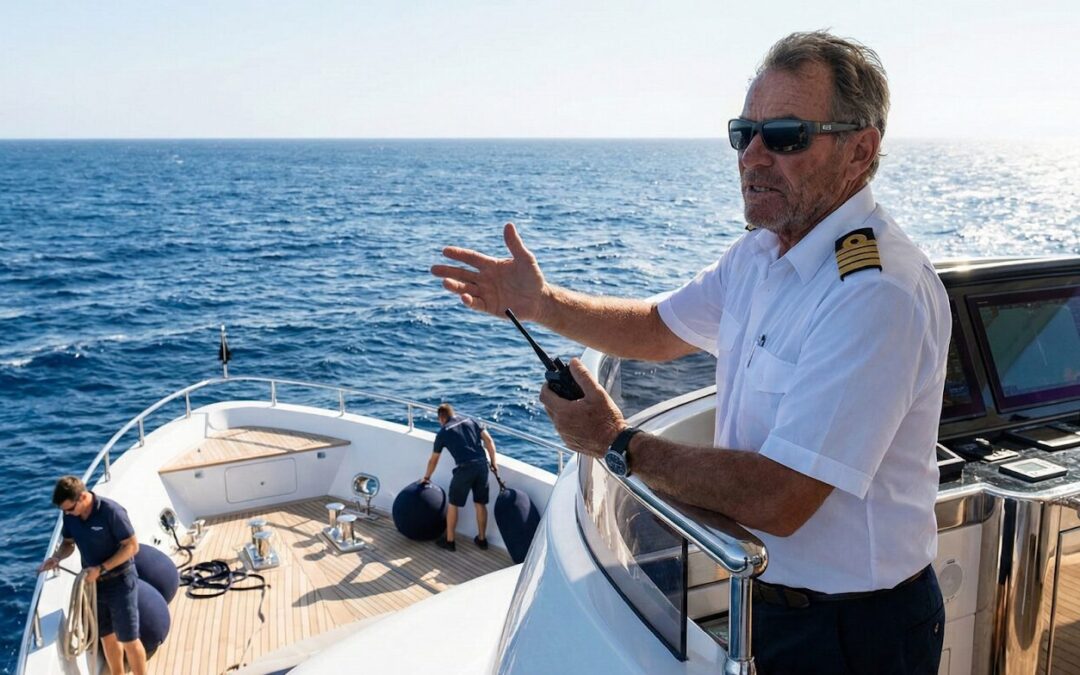
We all know the feeling: the boat’s moving, the breeze is behaving, and everything looks calm, until someone asks, “So… where are we exactly?” Suddenly, it’s very obvious who’s been quietly paying attention and who’s been vibing. The RYA Day Skipper Course by Certified Training is designed for that moment, because skippering isn’t about looking confident; it’s about being prepared.
This isn’t a “collect a certificate and hope” kind of qualification. It’s a practical, confidence-building step that helps us plan properly, make decisions sooner (not later), and lead a crew without turning the cockpit into an improv theatre of panic.
If we’re approaching Day Skipper as part of a bigger yachting career plan, we’ll also connect the dots with the wider yachting course ecosystem, especially where yacht training starts to overlap with professional requirements and crew pathways.
The course is designed for aspiring skippers who want to gain the skills and confidence to independently command a yacht up to 24 meters in familiar waters during daylight.
What is the RYA Day Skipper Course?
The RYA Day Skipper Course is a foundational skipper qualification that bridges the gap between being a competent crew and being the person in charge. In simple terms, it certifies that we can skipper a yacht in familiar waters by day, using solid navigation, seamanship, and decision-making.
It’s the kind of qualification that makes a difference when the plan needs tweaking because conditions changed, the tide didn’t play along, or the crew is looking at us for the next call.
Day Skipper is also a stepping stone. It’s not the “final boss” of RYA sailing qualifications, but it is a big milestone because it builds the habits that higher levels assume we already have. If we want to progress into Coastal Skipper or Yachtmaster routes later, this is where the foundation gets poured.
What’s the difference between Day Skipper Theory and Day Skipper Practical?
Think of the RYA Day Skipper theory course as brain training. We learn how to plan a passage, plot on a chart, calculate tides, understand the weather properly, and apply COLREGs in a way that makes sense at sea.
It’s the part that turns “I’ve heard of that” into “I can actually do it.”
The RYA Day Skipper practical course is the hands-on proving ground. We take the knowledge onboard and use it in real situations: leaving and arriving, close-quarters manoeuvring, pilotage, navigation by day, and running the boat in a way that keeps everyone calm and safe.
Practical training is also where we find out which habits we need to sharpen, because the sea is excellent at giving feedback.
Who should take the RYA Day Skipper Course?
The Day Skipper route fits neatly inside a broader yachting course pathway. For anyone aiming at professional crew work, it often sits alongside entry-level safety and onboarding training delivered through a superyacht training academy, before we start stacking higher-level skipper qualifications.
For leisure sailors, it’s often the point where we stop renting confidence from other skippers and start building our own.
It’s a strong fit if we’re in one of these camps:
- Aspiring skippers with some yachting experience who are seeking to become competent skippers and learn practical skills like pilotage and boat handling.
- Aspiring yacht skippers who want to plan and run day passages without relying on luck.
- Yacht crew moving into command roles where leadership is expected, not optional.
- Leisure sailors who want independence and the ability to sail with friends or family without always needing “the experienced one.”
- Charter clients who want to skipper their own yacht and be taken seriously by charter operators.
The course is designed for sailors with some experience who want to learn the basics of how to skipper a yacht safely. Students must have basic sailing ability and should hold the RYA Competent Crew Certificate before enrolling in the RYA Day Skipper course.
It’s also worth saying out loud: Day Skipper isn’t only for sailing yachts. It suits both sailing and motor cruising, and the practical endorsement will reflect the type of course we take.
Why the RYA Day Skipper Course is important
A lot of people can steer a boat, trim a sail, and make a tidy cup of tea. Skippering is different; it’s judgment, planning, calm leadership, and the ability to act early while the situation is still small. That’s why Day Skipper tends to feel like a “level up,” even for people who have plenty of time on the water.
The course builds confidence in a grounded way. Instead of hoping we’ll figure it out on the day, we learn a repeatable approach: plan the passage, brief the crew, monitor what’s changing, and adjust before we get boxed in. When we do this well, everyone on board relaxes, because the boat feels handled.
There’s also the recognition factor. The RYA Day Skipper certificate is widely understood by training organisations and commonly recognised by charter and boat-share providers as a meaningful sign of competence, especially when paired with a sensible logbook and real experience.
What does the RYA Day Skipper Course cover?
The RYA Day Skipper syllabus breaks into two tracks: shore-based knowledge (theory) and on-water competence (practical). Together, they cover the skills that stop small mistakes from becoming big problems, and they build the confidence to run a day passage without feeling like we’re winging it.
The course covers practical navigation, pilotage, boat handling, seamanship, and skippering techniques, including essential deck work.
The course aims to equip students with the skills and confidence to operate a small to medium-sized yacht safely and effectively.
Day Skipper Theory
The theory course is where we learn the “behind the scenes” of safe coastal sailing. It covers navigation and chartwork, tidal calculations, collision regulations (COLREGs), meteorology, safety procedures, passage planning, and basic pilotage.
The theory course also includes understanding international regulations for preventing collisions at sea, drift knowledge for calculating the effects of wind and tide, tidal streams, and estimating tidal heights (ep estimating tidal heights) as part of accurate navigation.
This isn’t about memorising facts for the sake of it. It’s about understanding what’s actually happening around us so our decisions are better than “it seems fine.” When we can calculate what the tide will do, plot a safe route, and understand what the weather is likely to bring, we stop being reactive.
The Day Skipper Theory course is a 40-hour program covering coastal navigation, tides, and meteorology, and students are expected to have a basic understanding of navigation and sailing ability before attempting the Day Skipper Practical course.
A quick example: a simple day hop between harbours can look easy on a map. Then we spot a shallow patch, a tidal gate, a wind shift, and a busy channel, and suddenly “easy” becomes “needs a plan.” That’s exactly the kind of thinking the theory course sharpens.
Day Skipper Practical
Practical training is where the learning gets real. We practise yacht handling under power and sail, berthing and close-quarters manoeuvring, skipper-level briefings, navigation by day, pilotage in familiar waters, and emergency drills.
The course emphasizes practical navigation, passage making, and pilotage meteorology, ensuring you gain the skills needed to skipper a small yacht safely by day in familiar waters.
This is also where leadership shows up, whether we like it or not. We learn how to delegate without barking orders, how to brief clearly without drowning everyone in detail, and how to keep the vibe calm while still being decisive. Students will practice boat handling skills such as bringing the boat safely to an alongside berth, mooring alongside, securing to a mooring buoy, handling mooring warps, weighing anchor, and changing sails to suit prevailing conditions. The course also covers essential maintenance tasks such as changing fuel and water filters.
The course is very hands-on and typically involves living on board a sail cruising yacht with crewmates and an instructor, and each trainee skipper is expected to take charge of the yacht on short passages.
Night Cruising: What You’ll Learn and Why It Matters
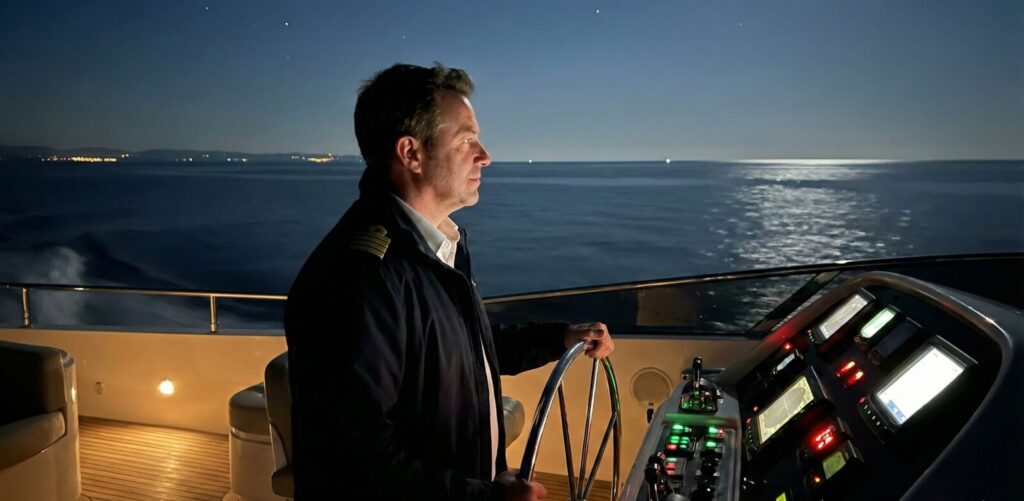
There’s something unforgettable about sailing at night, the world shrinks to the glow of your instruments, the hum of the wind, and the quiet focus of the crew. The RYA Day Skipper Practical course doesn’t just prepare you for sunny afternoons; it makes sure you’re ready when the sun goes down, and the real test of a skipper begins.
Night cruising is a core part of the skipper practical course, and for good reason. It’s where your theory knowledge and practical experience come together in a whole new way.
Under the guidance of your RYA instructor, you’ll learn how to handle a sailing yacht in darkness, navigating familiar waters with confidence and precision. This isn’t just about ticking a box; it’s about building the skills to keep your crew safe and your passage on track, even when visibility drops and every light on the horizon matters.
During the night cruising section, you’ll get hands-on with essential techniques like lead line pilotage and position fixing, using both traditional and modern methods to find your way.
You’ll practice identifying and avoiding relevant navigational hazards, adjusting your boat handling to suit prevailing conditions, and making smart decisions when the unexpected happens.
The course also covers the practicalities of maintaining your yacht at sea, checking fuel systems, managing victualling, and staying on top of maintenance tasks that keep your boat seaworthy through the night.
Safety is front and center. You’ll run through emergencies, from man overboard drills to helicopter rescue procedures, learning how to respond calmly and effectively. Your RYA instructor will help you develop a solid pilotage plan for night passages, ensuring you’re prepared for whatever the darkness brings.
To get the most from this part of the course, you’ll need to have completed the minimum pre-course experience, at least 5 days and 100 miles on a sailing yacht, plus 4 night hours. A good grasp of the Day Skipper theory course content is essential, as you’ll be putting that knowledge to the test in real time.
Complete the night cruising section, and you’ll earn a completion certificate that’s recognized internationally. You’ll also be eligible to apply for the International Certificate of Competence (ICC), opening up sailing in most European countries and beyond.
In short, night cruising is where the RYA Day Skipper Practical course proves its worth. It’s the difference between hoping you’ll manage after dark and knowing you can. Whether you’re aiming to skipper your own yacht, build towards higher qualifications, or just want to feel in control no matter the hour, this is the training that makes it happen.
Course format, duration, and assessment
How long is the RYA Day Skipper duration?
Day Skipper theory is commonly delivered as a structured course in a classroom or as an RYA Day Skipper course online. Practical training is typically run over about five days afloat, and some centres offer split formats such as weekends for people who can’t disappear for a full week.
A good planning tip is to treat theory as the setup and practical as the execution. If we do theory first, practical training becomes more about applying skills and less about trying to learn tides at the same time as learning berthing. That’s a much nicer way to live.
How does assessment work?
Day Skipper is mostly assessed through continuous observation, especially on the practical course. In other words, we’re judged on whether we can consistently make good decisions, run safe manoeuvres, and manage the crew across different scenarios.
For the theory course, there is an exam component. The important mindset is this: the exam is not the “goal,” it’s the quality check that confirms we can actually use the knowledge. If we can do the work, the exam tends to behave.
Online vs classroom Day Skipper theory
If we’re choosing between online and classroom theory, the best option is the one we’ll finish with confidence. Online learning wins on flexibility, especially if we’re balancing shift work, travel, or other training commitments. Classroom learning wins on structure and immediate feedback, which can make chartwork and tide calculations feel less like a solo mission.
Here’s a simple way to decide. If we’re self-motivated and happy to practise a little every week, online can work brilliantly. If we want someone to catch mistakes in real time, like a plotting error that quietly ruins our whole passage plan, classroom support often feels easier.
Experience and prerequisites
This is where a lot of people get in their own heads, so let’s keep it grounded. We don’t need to be an offshore legend, but we do need a baseline of competence and comfort onboard. Students should hold the RYA Competent Crew Certificate before enrolling in the RYA Day Skipper course, and basic navigation and sailing ability are assumed knowledge.
For the theory course, prior experience helps but isn’t always required. For the practical course, it’s typically expected that we can already manage basic sailing tasks and have a reasonable level of time onboard, because the instructor can’t build everything from scratch in five days.
If we’re brand new, pairing theory study with a short yachting course focused on seamanship basics can make the learning curve far less steep.
The RYA Competent Crew course is a recognized practical training program that provides essential sailing experience and prepares students for the Day Skipper course. It’s also a smart move if we haven’t sailed in a while and our confidence is a little dusty.
Is the RYA Day Skipper Course mandatory?
Legally mandatory? Usually not. Practically expected? Often, yes, depending on what we want to do.
If we plan to skipper a charter yacht, Day Skipper is frequently treated as a baseline qualification that demonstrates competence. If we want to progress toward Yachtmaster Coastal or other advanced RYA skipper training, Day Skipper is a strong stepping stone that makes the next level feel far more manageable.
The reality is simple: even when it’s not required by law, it’s commonly expected by people who need to trust us with responsibility. And that expectation exists for a reason.
RYA Day Skipper cost: how to think about pricing without getting played
The RYA Day Skipper cost varies a lot depending on where we train, what’s included, and how the course is delivered. Some providers include accommodation on board, fuel, course materials, and a more structured schedule; others quote a lower headline price and add the “extras” later. Mooring fees are often included in the course price, and accommodation is typically included in the course fee, often in shared cabins on board the yacht.
The easiest way to compare options is to compare like-for-like. We should ask what’s included, how much time we’ll actually spend practising key skills, and what support exists before and after the course. If we’re paying for training, we want time on the helm, not time watching someone else do it.
If we’re training in South Africa, we’ll often see people bundling their timeline around practical logistics, getting STCW course in Cape Town options booked, comparing STCW course price Cape Town across providers, and then lining up Day Skipper practical dates so the whole pathway flows without long gaps.
It’s not glamorous, but it’s the difference between a clean training plan and six months of awkward waiting.
The cost of the RYA Day Skipper Practical course can start from £399 per student and can cost up to £799 depending on the season. Additional costs may include transport to and from the school, meals, and personal items.
How the RYA Day Skipper Course supports career progression
For yacht crew, Day Skipper can be a turning point because it signals we can take responsibility, not just instructions. In many real-world hiring and placement scenarios, it complements foundational safety requirements like STCW basic safety training, and it’s commonly paired with other yacht training milestones as we build a credible, progression-ready CV.
Day Skipper also helps us “speak skipper.” We learn the language of passage planning, briefings, pilotage, and safe decision-making, which makes us more useful onboard even before we officially step into command roles. That matters on busy boats, where competent leadership is worth its weight in clean docking lines.
If we’re serious about command roles, it’s one of the most practical momentum moves we can make early. The smartest approach is treating it as part of a wider plan: pick a reputable superyacht training academy for foundational training, then stack Day Skipper and subsequent skipper qualifications in a way that matches the roles we actually want onboard. The RYA Day Skipper course serves as a foundation for advanced sailing qualifications like Coastal Skipper and RYA Yachtmaster, and a commercial endorsement for the RYA Day Skipper certificate enables you to work on small commercial vessels up to 24m.
Common mistakes the course helps prevent
Most onboard mistakes aren’t dramatic. They’re quiet, boring, and avoidable until they pile up.
The Day Skipper course helps us prevent the big four:
- Poor passage planning that ignores hazards, timings, and alternates.
- Misjudging tides and weather, especially when conditions shift faster than expected.
- Inadequate crew briefings that create confusion at the worst possible moment.
- Overreliance on electronics without maintaining strong fundamentals.
These are the mistakes that don’t feel like mistakes until they do. Day Skipper gives us a safer, more reliable default way of operating, so we don’t need perfect conditions to feel in control.
FAQs
What is the RYA Day Skipper Course?
It’s a foundational skipper qualification that develops the theory, knowledge, and practical competence to take charge of a yacht and crew in familiar waters by day. It’s designed to move us from confident crew to capable skipper, with real navigation and leadership skills.
The RYA Day Skipper course teaches you to confidently skipper a small yacht by day in familiar coastal waters, covering essential skills like navigation, boat handling, meteorology, safety, and crew leadership.
How long does the RYA Day Skipper Course take?
Theory is typically delivered as a structured course online or in a classroom, and practical training is commonly completed over around five days afloat. Some training centres offer split schedules, but the overall time commitment is similar once everything’s added up.
Can I do the RYA Day Skipper Course online?
Yes, the Day Skipper theory can be completed online. The practical course must be completed in person on the water, because there’s no substitute for real boat handling, real pilotage, and real decision-making in motion.
Do I need experience before taking the Day Skipper?
Some experience is strongly recommended, especially before the practical course. The more comfortable we are with basic sailing and navigation, the more we’ll get from the training, and the less we’ll feel like we’re sprinting to keep up.
Is a Day Skipper enough to charter a yacht?
Often yes, but it depends on the charter company and the cruising area. Many operators view Day Skipper as proof that we can skipper responsibly, but it’s always worth confirming the specific requirements before we book a boat and start daydreaming.
What comes after the RYA Day Skipper Course?
Many sailors progress toward Coastal Skipper and Yachtmaster pathways, building experience and confidence as they go.
The RYA Day Skipper course serves as a foundation for advanced sailing qualifications like Coastal Skipper and RYA Yachtmaster. Day Skipper is also a solid base for strengthening our on-the-water leadership and keeping future training far less intimidating.
Conclusion
The real value of the RYA Day Skipper Course isn’t just the certificate, it’s the shift in how we operate. We stop relying on instinct alone and start using a repeatable process: plan well, brief clearly, navigate confidently, and adjust early.
If we want the biggest payoff, we treat theory as the foundation and practice as the proving ground. Then Day Skipper becomes what it’s meant to be: the point where we stop being passengers in the plan and start being the person who makes it happen.