
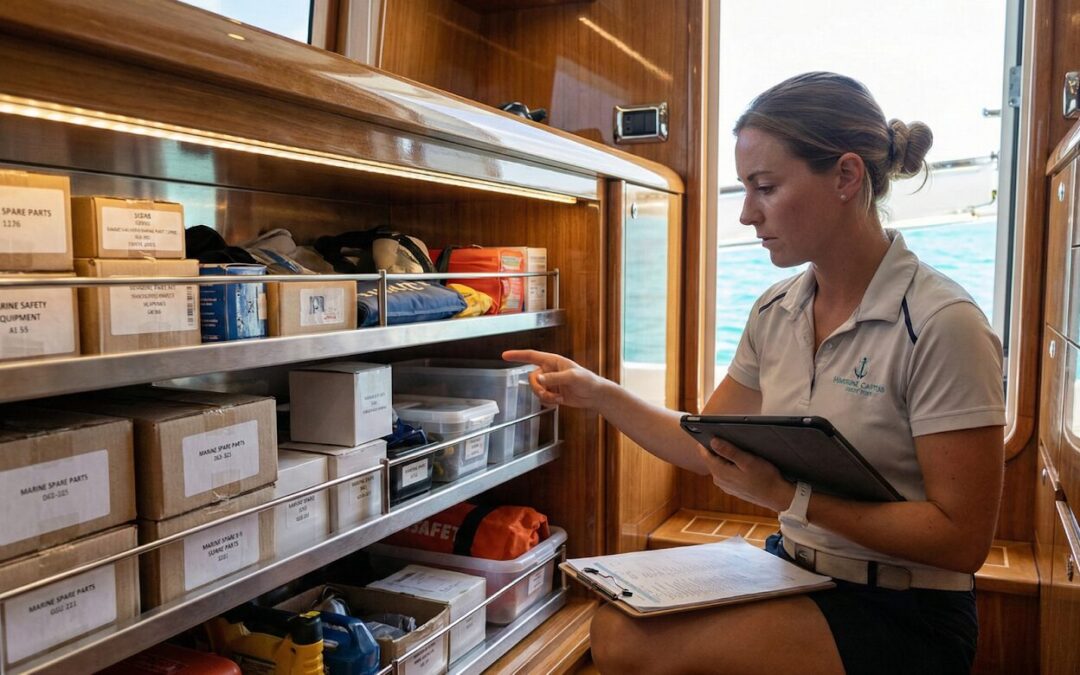
Luxury rarely falls apart in dramatic ways. It slips through the cracks when a guest’s preferred tonic is missing, when the right spare can’t be found fast enough, or when the “we definitely have that” turns into a frantic locker-by-locker treasure hunt.
On a superyacht, those small misses don’t stay small for long; they disrupt service, inflate costs, and spike stress across the whole vessel.
That’s exactly why superyachts’ inventory management training is no longer a side skill reserved for “the organized one.” It’s an operational discipline that keeps a yacht ready, compliant, and consistently exceptional, even when the itinerary changes or the season throws curveballs.
Inventory management training is specifically designed to solve the unique needs and challenges faced by yacht owners and captains, ensuring that every aspect of inventory is handled efficiently and proactively.
When inventory systems are strong, the yacht feels calm and professional. When they’re weak, the yacht still looks beautiful, right up until the moment it doesn’t.
What we’re aiming for here is simple: a practical, magazine-quality guide to how inventory works in the real superyacht world, what Certified Training covers, and how it connects to standards, systems, guest experience, and career progression. If we get inventory right, we quietly protect everything else onboard.
For example, during a busy charter, a well-trained crew used their inventory system to quickly locate a critical spare part, preventing a last-minute service failure and keeping the guest experience seamless.
What is superyacht inventory management?
Superyacht inventory management is the structured process of keeping track of what the yacht owns and consumes, where it’s stored, what condition it’s in, who’s responsible for it, and when it needs replacing.
That includes ordering, receiving, storing, issuing, auditing, reconciling, and documenting stock across departments. It’s not “counting things”; it’s running an operational system that supports service standards, maintenance readiness, and cost control.
Inventory control is more complex on yachts than in land-based hospitality because a yacht operates in a moving supply environment. Deliveries depend on ports, customs realities, supplier lead times, itinerary changes, and storage limitations that would make a warehouse manager cry into their clipboard. On land, you can usually fix a mistake with a same-day order and extra shelf space. At sea, a mistake can follow you for weeks.
Users, including crew members and management staff, interact with the inventory system, and access is managed through user accounts and permission levels to ensure security and scalability.
At the heart of it is accountability, traceability, and operational readiness. Accountability means we know who owns which part of the process, so “someone” isn’t responsible (which usually means no one is).
Traceability means we can explain what happens when something goes missing, expires, or breaks, without turning it into a blame festival. Operational readiness means the yacht can deliver luxury and safety standards consistently, even under pressure.
Centralized databases in superyacht management play a crucial role by preventing duplicate orders and conflicting stock counts, ensuring that all users are working with accurate, up-to-date information. This streamlines operations and reduces costly errors.
What are the core inventory categories on a superyacht?
Inventory is typically grouped into a few main categories, and each category has different rhythms and risks. If we manage all stock the same way, we get predictable chaos. If we manage each category with the right method, inventory becomes boring, and boring is the goal.
Interior inventory includes linen, towels, tableware, glassware, uniforms, guest amenities, minibar items, cleaning supplies, and service equipment. It’s guest-facing, fast-moving, and sensitive to quality and presentation, which makes accuracy essential.
Having “some towels” isn’t the same as having the right sizes, the right condition, and the right par levels for turnover.
Exterior inventory covers deck equipment, maintenance supplies, deck consumables, watersports gear, lines, fenders, protective equipment, and often tender-related items. It lives in harsh conditions, salt, sun, wear, so condition and replacement timing matter as much as quantity. It’s also itinerary-driven, meaning destination changes can change needs overnight.
Engineering inventory includes spares, tools, filters, oils, consumables, and critical components tied to maintenance and safety. This is where inventory mistakes can become expensive fast, because missing a small part can create downtime or force costly rush orders.
Recording the manufacturer and model for spare parts and equipment is essential for accurate reordering and maintenance planning. A disciplined approach here supports planned maintenance rather than reactive maintenance.
Provisions inventory includes food, beverages, wines, specialty items, and dietary-specific stock. It’s perishable and preference-driven, which makes forecasting tricky, especially with changing guest profiles. Good provisioning systems reduce waste while still protecting guest experience and crew welfare.
ABC analysis is commonly used to categorize inventory items based on their value and usage, helping focus management efforts where they matter most.
Why is inventory management critical for superyacht operations?
Inventory management protects the yacht in four big ways: guest experience, operational continuity, budget control, and compliance readiness.
Modern inventory management systems offer features such as real-time tracking, automated alerts, and reporting tools that help maintain these pillars by streamlining operations and enhancing usability. If inventory is weak, the yacht becomes reactive. Reactive operations are expensive, stressful, and usually visible to guests, even if we try to hide the scramble with smiles.
Guest experience disruptions are the most immediate consequence. A missing guest preference, a broken service item without a replacement, or an inconsistent standard in amenities can turn “effortless luxury” into “almost luxury.” Guests may never say “your inventory was bad,” but they absolutely notice when a yacht can’t deliver what it usually delivers.
Operational delays are the second domino. Missing spares or consumables can slow maintenance, limit equipment use, delay turnarounds, and affect safety and service delivery. Even something as simple as not having the right cleaning chemical can change how quickly a department can reset after guests.
Budget overruns often hide inside messy inventory. Duplicate ordering happens when the crew can’t trust the records or can’t find the stock quickly. Waste increases when items expire or degrade due to poor storage.
Just-In-Time (JIT) strategies involve ordering small, frequent shipments to reduce holding costs, while Just-In-Case (JIC) strategies focus on keeping critical spares in stock to ensure readiness.
Each approach impacts inventory costs and operational preparedness differently. Cost control becomes guesswork, and guesswork is a hobby, just not one owners love paying for.
Compliance and audit risk is the quieter, sharper edge. Inventory records and procedures often support inspections and audits by showing the yacht can demonstrate control, traceability, and operational readiness.
When documentation is disorganized, inspections get longer and more uncomfortable, and handovers become more fragile. Inventory isn’t just “stores”, it’s operational credibility.
Who needs certified inventory management training on superyachts?
Anyone responsible for ordering, storing, issuing, budgeting, or handovers should take inventory training seriously. But certain roles feel the impact most, because they sit closest to the pressure points. Certified training helps those roles lead with confidence instead of relying on tribal knowledge.
Chief Stews benefit because the interior inventory is both extensive and highly visible. Linen par levels, guest amenities, uniforms, service items, and presentation standards live in their world. When interior inventory is sharp, service becomes smooth, consistent, and quietly impressive.
Purchasers and yacht administrators benefit because they often manage purchasing processes, documentation, budgets, supplier coordination, and cross-department consistency.
They’re the bridge between onboard needs and shore-side expectations, which is where misunderstandings and cost leaks often happen. Strong inventory systems turn that bridge into a reliable pipeline instead of a daily firefight.
Chief Officers benefit because deck stores and operational readiness sit under their oversight. Exterior inventory tends to be exposed to wear and relies on routine replenishment and condition tracking. Training helps officers build structured control without slowing operations.
Engineers benefit because technical spares and consumables are mission-critical. A well-managed engineering store supports planned maintenance, reduces downtime, and makes it easier to justify critical purchases. It also prevents the “we ordered that last month” mystery that wastes both time and budget.
New crew transitioning into senior roles benefits differently: training accelerates professional maturity. The jump from junior to senior isn’t just competence; it’s systems ownership.
Inventory training teaches how to run a repeatable process and how to hand it over cleanly, which is exactly what leadership roles demand. Students in advanced superyachts inventory management training programs gain additional support and opportunities to develop these leadership skills.
The TYSA Advanced Interior Management course is designed for interior crew with 3+ years of experience.
What does certified superyacht inventory management training cover?
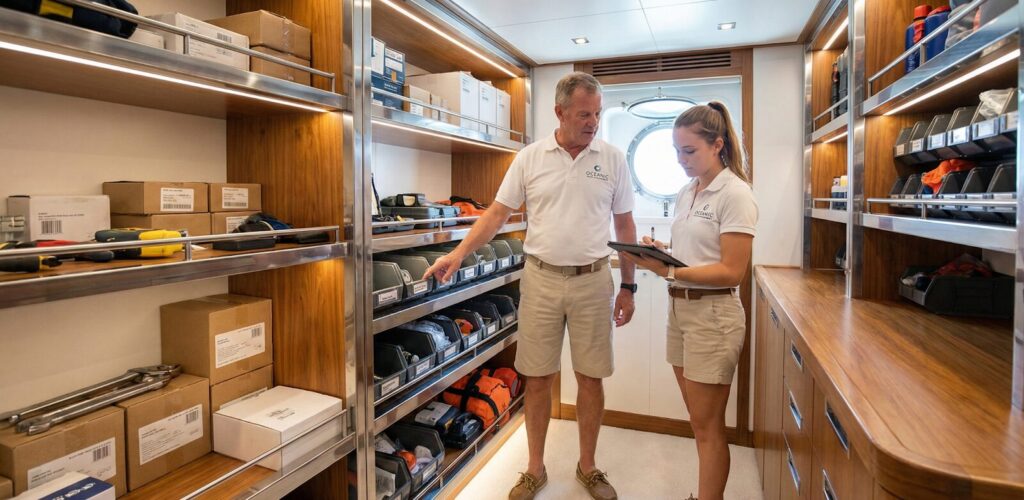
Training for superyachts inventory management is organized into modules, each focusing on different aspects of inventory management such as categorization, ordering, budgeting, and audits.
A good training program builds competence from the ground up, focusing on repeatable systems and real onboard constraints. It’s not about perfect spreadsheets, it’s about practical control, smart forecasting, clean documentation, and a process that survives crew rotations.
Training also reduces the “everyone does it differently” problem, which is the fastest way to create inventory drift.
The foundation is inventory categorization and standardization. If different crew members name the same item differently, tracking breaks. Training teaches consistent naming conventions, category logic, storage mapping, and standard item descriptions so the system stays coherent even when staff changes.
Next comes stock level setting and par levels. Par levels should be based on real usage, lead times, storage constraints, and risk, not vibes. Training shows how to set sensible minimums and maximums, and how to adjust them for itinerary changes, charter intensity, and seasonality.
Then we move into ordering cycles and supplier coordination. On yachts, ordering is a logistics exercise, not a quick shop. Training teaches how to plan around ports, delivery windows, customs, and supplier reliability, so we’re not gambling on last-minute arrivals.
Budget tracking and cost control are a core competency, not an optional extra. Training helps tie spending to departments, operational priorities, and realistic monthly targets. It also teaches how to spot the usual financial leaks, duplicate orders, uncontrolled issuing, poor tracking of breakages, and “emergency” purchases that weren’t really emergencies.
Storage planning in limited spaces is where yacht reality kicks in. Storage isn’t just “where it fits”; it must be safe, logical, and fast to access. Training covers labeling, zoning, condition protection, hazardous storage considerations, and how to keep stores usable under high pace.
Then there are inventory audits and reconciliation. This includes cycle counts, spot checks, variance tracking, and corrective action that strengthens the system without creating fear. When audits become routine, inventory becomes more accurate, and the yacht becomes less reactive.
Most modern programs also include waste reduction and sustainability practices because waste is expensive. Waste reduction improves budget control, reduces emergency ordering, and often improves storage hygiene and safety. It also supports better provisioning outcomes, especially in perishable categories.
Throughout the training, students receive guidance to help them complete assignments and meet course expectations.
Finally, training emphasizes documentation for inspections and handovers. A yacht can be well stocked and still look unprofessional if records can’t prove control. Clean documentation makes inspections smoother and handovers less risky, because incoming crew can trust what they’re inheriting.
The training develops practical skills that enhance job readiness and professional competence, contributing to a deeper understanding of inventory management and yacht operations.
The Yacht Stew Academy offers a course on Advanced Interior Management that addresses various inventory and service aspects. The TYSA course includes practical exercises and simulations to apply theoretical knowledge, and assignments must be submitted for review to pass.
Setting up inventory systems on board
Setting up inventory systems on board is the foundation for the successful completion of daily duties and smooth yacht operations. For a chief stewardess or any member of the interior crew, being able to easily manage and keep track of spare parts, equipment, and essential items is non-negotiable.
The process starts with creating a comprehensive inventory list that covers every item, down to the last napkin or gasket, so all the information is in one place and accessible to those who need it.
Assigning clear tasks to crew members ensures that everyone is on the same page, whether it’s restocking guest amenities or logging new equipment. Designating specific storage areas for different categories, interior, exterior, and engineering, makes it easy to manage and locate items quickly, reducing time spent searching and minimizing disruption to service.
This organized approach not only supports daily operations but also provides a reliable reference for future maintenance, repairs, and safety checks. With a well-structured inventory system, the crew can confidently manage the vessel’s needs, streamline handovers, and ensure that nothing slips through the cracks, keeping the yacht ready for whatever comes next.
Spare parts management strategies for superyachts
Managing inventory of spare parts is a critical strategy for keeping superyachts running smoothly and avoiding costly downtime. The key is to identify which spare parts are essential for the vessel’s operation and maintenance, such as filters, belts, pumps, and specialty items unique to your yacht’s equipment.
Once these have been identified, determining the right quantities to keep on board is vital; too few, and you risk delays, too many, and you waste valuable storage space.
A robust system, whether specialized software or a dedicated crew member, should be in place to track and manage spare parts inventory. This allows the crew to easily manage stock levels, monitor usage, and prepare for scheduled maintenance or unexpected repairs without hassle.
By keeping the system up to date, the crew can maintain the vessel’s health, support ongoing operation, and be ready for future needs. Ultimately, effective spare parts management means less stress, fewer last-minute emergencies, and a yacht that’s always ready to deliver top-tier service.
Order management and procurement essentials
Order management and procurement are the backbone of a yacht’s ability to stay stocked and ready for guests. The crew must be able to easily manage orders, track shipments, and ensure that every item, whether for the galley, interior, or engine room, arrives on time and in the right quantity.
A centralized system, accessible to authorized crew, is essential for keeping all procurement details organized and up to date.
By streamlining the order management process, the crew can reduce errors, avoid duplicate orders, and save valuable time. This system also allows for better planning and budgeting, as all aspects of inventory and procurement are tracked in one place.
With clear records and accessible data, the vessel can operate efficiently, respond quickly to guest requests, and plan for future needs without scrambling.
Ultimately, a well-organized order management system ensures the yacht is always prepared, supports smooth operations on board, and helps maintain the high standards guests expect.
What inventory management systems are used on superyachts?
Yachts generally use either manual systems, digital systems, or a hybrid. Manual systems usually mean spreadsheets, paper logs, and department-specific trackers.
They can work on smaller vessels or stable programs with consistent crew, but they’re prone to human error and tend to break under charter pace or frequent crew turnover.
Digital systems are increasingly common because they reduce friction and improve visibility.
These systems often require each user to have an account, with access controls and permissions to ensure data security and proper user management. Real-time tracking supports faster decision-making, centralized access reduces confusion, and reporting helps budgeting and forecasting become more accurate.
Digital systems also help maintain continuity across rotations, because the “how we do it” can live inside the system instead of in someone’s memory. Managing a fleet of yachts is also streamlined through digital platforms, which support fleet management features for clients with multiple vessels.
The power of technology harnesses automation and integration to streamline yacht configuration and maintenance, making operations more efficient. The team responsible for inventory management can collaborate more effectively through these platforms, assigning tasks and sharing information seamlessly.
The key point is that training should focus on systems thinking, not tool worship. Inventory software may change between yachts and management companies. When we understand the principles, categorization, par levels, ordering cadence, issuing control, audits, and documentation, we can adapt quickly to whatever platform a yacht uses. Training builds that portability.
DockMaster and DeepBlue are yacht management platforms that offer training for parts and inventory tracking. Modern superyacht inventory management is increasingly conducted through proprietary marine software.
Quartermaster is a comprehensive yacht management software solution that helps you organize all of your yacht’s data in one place. Quartermaster provides an easy-to-use dashboard to organize your yacht’s systems, an electronic logbook for your log entries, and a way to track services needed for each system with configurable reminders.
Quartermaster allows you to add crew to your yacht and assign them tasks for better collaboration. Quartermaster’s system uses state-of-the-art, industry-standard infrastructure and encryption to ensure data security. Quartermaster also allows you to track your yacht and show your track on a map if you have an Iridium Go device.
Security and access control in yacht inventory management
Security and access control are essential for protecting the yacht’s inventory, from spare parts to high-value equipment. The crew must ensure that all items are stored securely, using designated storage areas, locked cabinets, and restricted access zones for sensitive or expensive stock.
By implementing clear access controls, the crew can prevent theft, loss, and accidental damage, while still ensuring that inventory is easily accessible to those who need it.
A secure inventory management system allows the crew to track who accesses what, when, and why, making it easier to maintain accountability and keep accurate records. This not only protects the vessel’s assets but also supports safety and operational readiness.
With the right controls in place, the crew can manage inventory efficiently, respond quickly to maintenance needs, and ensure that the yacht is always prepared for any situation, without compromising security or accessibility.
Certified training vs on-the-job learning: what’s the difference that actually matters?
On-the-job learning is how many crew begin, and it’s valuable because it’s grounded in real yacht life. The problem is that it’s inconsistent. If the yacht’s system is weak, we inherit weak habits, and those habits become “normal” until they cause a visible failure.
On-the-job learning also depends on who’s teaching. If the person training us improvises or skips documentation, we learn to improvise and skip documentation. That works until the day it doesn’t, usually during a busy charter or just before an inspection, which is not a great time to discover the system is held together with optimism.
Certified training creates standardization. It builds a shared vocabulary and shared methods that are transferable across vessels. Completing certified training results in a certificate, which is a valuable credential for professional development and credibility in the superyacht industry. Certified training also includes prep activities such as hands-on exercises, skills development, and exposure to industry standards, all designed to prepare students for a professional career at sea.
Career progression is the blunt truth here. As we move into senior roles, we’re expected to run systems, manage budgets, and reduce risk, not just complete tasks. Certification helps signal readiness, and it often makes the difference between being seen as “helpful” and being seen as “hireable for leadership.”
Acquiring relevant qualifications through certified training, such as mandatory safety certifications and specialized hospitality training, is essential for advancing in the superyacht industry.
For example, the Certified Training Superyacht Stewardess/ Steward Course is a training program designed for careers aboard luxury yachts. We also have key maritime qualifications such as STCW Basic Safety Training, Powerboat Level 2, and VHF Radio.
It also offers hospitality-focused training through the globally recognized GUEST programme, and students can enhance their training with a module from the British Butler Institute. UKSA provides career support, including CV workshops and job interview preparation, further supporting students’ entry into the industry.
Compliance, standards, and regulatory alignment: where inventory fits in
Inventory can feel like a purely operational topic until we connect it to standards and inspection expectations. Many yachts operate with an eye toward ISM Code principles, especially around documented procedures, operational control, and readiness.
Inventory records and procedures support those outcomes by proving the yacht can demonstrate control of critical supplies and consistent processes.
It’s important to note that private yachts and chartered yachts may face different compliance and inventory management requirements, with private vessels often having more personalized arrangements and potentially distinct standards to meet.
STCW is typically the baseline for safety and seafarer competence, and while inventory management isn’t always a named STCW module, its discipline supports safer operations. Strong inventory systems reduce rushed improvisation, which is where safety and compliance issues often start. In other words, inventory doesn’t replace STCW; it complements it by strengthening operational professionalism.
Flag state and class expectations also shape what “good” looks like. Inspections often go smoothly when the yacht can produce clear records and demonstrate consistent procedures.
Clean inventory documentation supports audits and handovers, and it reduces the risk of operational gaps being exposed at the worst time. Regular audits and cycle counts are important for reconciling physical stock with digital records, ensuring accuracy and compliance.
Best practices taught in professional training programs
Professional training focuses on practical best practices that protect continuity and accountability. These practices help teams keep standards consistent across rotations and reduce the “reinvent the system every season” problem. They also create calmer departments, because everyone understands how stock moves and who owns what.
Here are the best practices we see repeatedly in strong programs (and yes, the yachts that do these tend to sleep better at night):
- Establishing SOPs for inventory handling, covering ordering, receiving, issuing, storage, and returns.
- Clear handover procedures between crew rotations, including counts, known variances, and storage maps.
- Segregation of duties for accountability, so purchasing, receiving, and approvals aren’t overly concentrated without oversight.
- Emergency stock planning for mission-critical spares and “no-fail” guest essentials.
- Seasonal and itinerary-based inventory forecasting, adjusting par levels for guest profiles and cruising grounds. Demand forecasting should use historical usage, seasonal trends, and guest preferences to accurately predict needs.
- Routine cycle counts and reconciliation, catching issues early instead of doing panic audits.
Automated reorder points alert users when critical items reach minimum stock levels, ensuring timely replenishment. Strong supplier relationships are critical for reliable and timely deliveries of specialized marine parts.
Documentation is essential, uploading manuals and maintenance logs ensures important information is always available for future reference.
These are not “extra admin.” They’re guardrails that keep the yacht operationally stable. When these practices are in place, inventory becomes predictable. When inventory is predictable, service and maintenance become easier, budgets become cleaner, and handovers become less risky.
For custom solutions or support with your superyachts’ inventory management training, contact our team directly.
Reporting and analytics: turning inventory data into action
Reporting and analytics transform raw inventory data into actionable insights that drive smarter decisions on the board. By regularly analyzing inventory levels, usage trends, and procurement patterns, the crew can identify opportunities to optimize stock, reduce waste, and improve efficiency.
Specialized software or a dedicated crew member can help collect and interpret this data, making it easy to spot patterns and anticipate future needs.
With robust reporting, the crew can create a more responsive and effective inventory management system, ensuring the vessel is always well-stocked and ready for guests. Data-driven decision making also supports better planning for maintenance, repairs, and provisioning, helping the yacht stay ahead of potential issues.
Ultimately, leveraging analytics means the crew can prepare for changing circumstances, maintain high standards, and deliver a seamless experience for both guests and crew, now and in the future.
How does inventory management training improve guest experience?
Guest experience is built on invisible consistency. When everything appears effortlessly available, exactly the right beverage, the right amenities, the right service items, guests relax into the luxury. Inventory is one of the main engines behind that ease, because it’s what allows service teams to say “of course” without silently praying.
Personalization is where inventory readiness really shines. Guests don’t just want luxury; they want their luxury, which often means specific brands, dietary preferences, and small rituals they expect to be remembered.
Training teaches how to capture those preferences reliably and translate them into provisioning and stock planning so we’re not guessing mid-charter.
There’s also the operational side of guest experience, which guests feel, even if they don’t know why. Missing spares can take toys offline, delay tender operations, or force changes to plans.
When technical inventory is disciplined, the yacht stays functional and polished, and guests experience a program that feels seamless rather than fragile.
Interior standards also live and die by inventory. Linen quality, table presentation, glassware availability, minibar consistency, and the ability to reset quickly after guests are inventory outcomes.
Training helps keep luxury standards steady without exhausting the crew, because the system reduces wasteful searching, last-minute ordering, and repeated mistakes.
Career benefits of certified superyacht inventory management training
Inventory training is one of the most underrated career accelerators in yachting because it signals operational maturity. It shows that we understand systems, accountability, documentation, and cost control, the stuff that keeps a yacht professionally managed.
Captains and management companies tend to trust crew who can run processes, not just perform tasks.
Certification also practically strengthens CVs. It supports promotion into senior interior roles, purser/administrator roles, and operations-heavy leadership positions where budgets and consistency matter daily. When a yacht needs someone to “own” inventory and keep standards stable across rotations, trained crew are simply easier to back.
Most importantly, it’s a portable skill. Yachts change, tools change, and programs evolve, but the underlying principles of maritime inventory management stay valuable everywhere.
When we invest in superyachts inventory management training, we’re investing in a capability that improves employability and readiness across vessels, without needing to relearn the basics every time we step aboard a new program.
FAQs About Superyacht Inventory Management
What is superyacht inventory management?
Superyacht inventory management is the structured process of tracking, ordering, storing, issuing, and auditing stock across all departments onboard. It supports operational readiness, cost control, and consistent guest standards. It also improves accountability and makes handovers and inspections smoother.
Why is inventory control important on superyachts?
Inventory control prevents guest disruptions, operational delays, and budget overruns caused by emergency ordering, waste, or duplicated purchases. Keeping track of inventory and spare parts helps prevent disruptions and supports smooth operations by ensuring that usage is monitored and shortages are avoided.
It also supports inspection and audit readiness through traceable records and consistent procedures. Strong systems reduce stress because problems stay visible and manageable.
Who should take superyacht inventory management training?
Chief Stews, pursers/administrators, chief officers, and engineers benefit most because they manage high-impact stock categories and processes. Crew transitioning into senior roles also benefits because leadership requires systems ownership, not just task execution.
If we handle ordering, storage, issuing, or audits, training pays off quickly. Students who enroll in superyachts inventory management training programs gain valuable skills and support tailored to their roles, enhancing their effectiveness both during and after the course.
Is inventory management part of STCW training?
STCW focuses on safety and competency standards for seafarers and is often required for yacht crew roles. While inventory management is not a core STCW qualification, it is an important professional skill that complements other qualifications, such as mandatory safety certifications and specialized hospitality training.
Good inventory discipline supports a safer, more compliant onboard culture by reducing rushed improvisation.
What systems are used for yacht inventory management?
Some yachts use manual systems like spreadsheets and paper logs, while many use digital platforms for real-time tracking, centralized access, and reporting. Digital inventory systems also allow multiple users, such as crew members, to have different access levels, ensuring secure and scalable management.
Hybrid systems are also common, especially during transitions. Training helps because it teaches the underlying principles that work across any tool.
Does certified training help with career progression?
Yes, because it demonstrates standardized competence, accountability, and operational professionalism. Earning a certificate in superyachts inventory management not only validates your expertise but also supports career progression by providing official recognition of your skills.
It strengthens CVs, supports promotions to senior interior or operations roles, and builds confidence in your ability to lead a system. In a competitive industry, it’s a strong signal that we’re ready for more responsibility.
Conclusion: the quiet system that keeps luxury loud
If we strip away the gloss, inventory is really about trust. Trust that the yacht can deliver what it promises, trust that departments aren’t stepping on each other’s toes, and trust that when something goes wrong, the fix is already within reach.
The best inventory systems don’t feel restrictive; they feel like relief, because they replace constant “just in case” stress with predictable routines.
That’s what superyachts’ inventory management training gives us: a shared way of working that survives busy charters, crew rotations, and shifting itineraries. It helps us make smarter calls on par levels, purchasing, storage, and documentation, so we’re not burning hours searching, re-ordering, or apologizing.
The practical skills gained from this training are recognized across the industry, enhancing job readiness and professional competence. Over time, that competence becomes part of the yacht’s signature, and guests feel the smoothness even if they never see the storerooms.
And for our careers, it’s one of the cleanest signals of professionalism we can put on the table. Anyone can say they’re “organized,” but a trained crew member can run a system, lead a handover, and protect a budget without turning it into a drama series.
When we’re ready to move up, that’s exactly the kind of capability that gets noticed and remembered. Advanced certifications in superyachts’ inventory management are designed to prepare crew for handling high-value assets unique to the superyacht environment.