
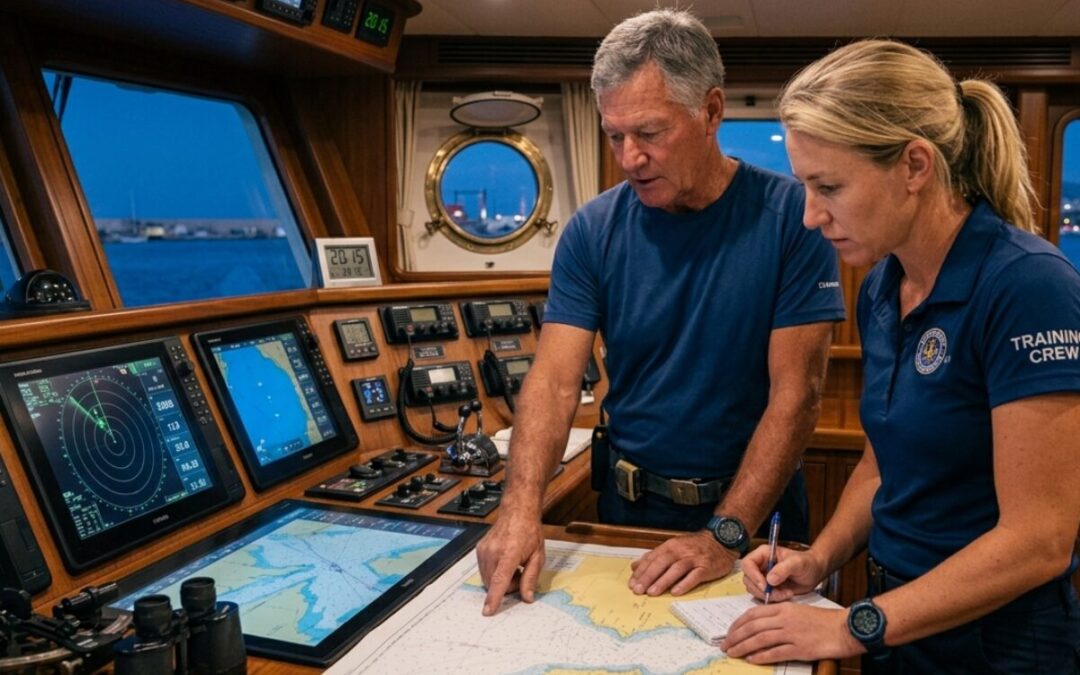
Standing on the aft deck with a chamois in hand is where almost every superyacht captain begins. The journey from an entry-level deckhand to commanding a multi-million-dollar motor yacht is one of the most structured and rewarding career paths in the maritime industry.
It is a transition that moves you from physical exterior maintenance to high-level navigation, crew management, and ultimate legal responsibility.
Every aspiring deckhand must complete essential certifications like the STCW course before stepping aboard commercially. The yacht officer career progression is built on a clear framework regulated by maritime authorities like the Maritime and Coastguard Agency (MCA).
To climb the ranks, you must combine verified sea service with mandatory academic study modules and rigorous oral examinations. Understanding this professional roadmap early allows ambitious crew members to plan their training strategically and advance with purpose.
Whether you are stepping aboard your first vessel or preparing for your first bridge ticket, each rank serves as a vital stepping stone. Let us break down the exact steps required to complete the pathway from deckhand to superyacht captain.
Step 1 – What Fundamental Deck Duties and Basic Safety Training Build the Foundation for Future Command?
Every great captain understands how a yacht operates from the waterline up. Your early months and years on the deck are not just about keeping the vessel clean; they are about developing an intuitive understanding of seamanship, material care, and guest safety.
How Do Daily Maintenance and Washdowns Prepare You for Senior Ranks?
Mastering exterior care, teak treatment, paint maintenance, and varnish work instills the high vessel standards expected of a bridge officer. When you clean and maintain a superyacht, you learn how harsh salt environments affect different materials and structural components over time.
This hands-on deck experience builds a deep understanding of hull protection, guest safety, and equipment longevity. Officers who start as deckhands know exactly how long maintenance tasks take, how to spot early wear on critical hardware, and how to direct crew efficiently.
Completing a foundational entry-level deckhand training course alongside a professional yachting course provides the core practical skills needed to excel in these initial deck responsibilities.
Why Is Mastery of Line Handling and Tender Operations Essential for Promotion?
Mooring, anchoring, and operating tender craft in busy marinas develop core seamanship skills that cannot be learned solely in a classroom. Handling heavy lines under tension and managing fenders during high-wind docking operations teaches you how wind, current, and vessel displacement interact.
Driving guest tenders builds spatial awareness, throttle control, and basic navigation judgment needed later on the bridge. A deckhand who can comfortably handle a twin-engine tender in a crowded harbour demonstrates the calm, calculated handling required of a future bridge officer under pressure.
Step 2 – How Do You Accurately Record and Verify Your Sea Service?
Sea service is the legal currency of the maritime industry. You cannot enroll in officer modules or sit for official MCA exams without proving that you have spent the required amount of time living, working, and navigating at sea.
What Types of Sea Days Qualify for Officer Certification?
Maritime authorities make strict legal distinctions between different types of time spent aboard a vessel. To qualify for officer tickets, your service must be broken down accurately according to official guidelines:
- Active Sea Days: Days where the vessel is at sea, underway, or engaged in active passage making.
- Watchkeeping Hours: Actual hours spent performing bridge navigation duties under the direct supervision of a qualified officer.
- Stand-by Periods: Days spent aboard in full readiness for sea, typically in port or at anchor during a charter or owner trip.
- Yard & Maintenance Time: Time spent in shipyards or refit facilities, which counts toward general sea service but has strict upper limits for officer ticket applications.
Understanding these criteria ensures that your service record meets the exact standards required when maritime authorities audit your application.
How Do You Maintain an Audit-Ready Seafarer Discharge Book, Testimonial Log, and STCW Revalidation?
Maintaining an accurate record requires discipline from day one. You must record your time in an official seafarer discharge book and back up every entry with a formal sea service testimonial signed by the captain or chief engineer.
Your initial yacht training instills the habit of tracking every nautical mile accurately. Having a valid STCW certificate stored safely alongside your testimonials prevents administrative delays when registering for higher officer modules, especially because it is required for certain personnel sailing beyond U.S. waters and working in international waters.
Common record-keeping errors, such as missing captain signatures, incorrect dates, missing vessel official numbers, or vague descriptions of vessel gross tonnage (GT), frequently lead to rejected sea service applications during officer ticket processing.
Always request signed testimonials before leaving any vessel or at the end of every charter season, and keep secure digital copies backed up safely online.
Step 3 – How Do You Transition from Entry-Level Deckhand to Bosun?
Moving from deckhand to lead deckhand or bosun is your first major step into leadership. It marks the transition from executing daily task lists to taking responsibility for deck personnel, organizing work schedules, and maintaining vessel inventory.
What Supervisory Responsibilities Prove You Are Ready for the Bosun Role?
The shift to bosun requires taking ownership of the exterior team’s daily routine and overall presentation. Instead of waiting for a task list, a prospective bosun organizes deck wash schedules, delegates routine maintenance, and inspects junior crew work to ensure it meets superyacht standards.
You also take on the responsibility of managing water sports equipment, tender staging, safety equipment checks, routine emergency procedures, and deck inventory control. Demonstrating that you can run a safe, efficient deck while keeping crew morale high proves to the captain that you possess the leadership potential needed for bridge responsibilities. Enrolling in a basic superyacht deckhand package helps build the comprehensive technical foundation required to step into these supervisory roles.
Which Intermediate Deck Qualifications Strengthen Your Promotion Prospects?
Earning targeted intermediate qualifications makes your profile stand out when lead deckhand or bosun positions open up aboard larger vessels. Key credentials to target include:
- RYA Powerboat Level 2 & Tender Operator: Proves advanced watercraft handling and guest transfer safety skills.
- RYA Yachtmaster Offshore: Builds foundational navigation, chartwork, weather reading, and skipper judgment.
- Navigational Watch Rating (NWR): Qualifies you to hold formal, unassisted navigation watches under officer supervision.
- Efficient Deck Hand (EDH): Demonstrates advanced seamanship, rigging, ropework, anchor handling, and deck safety.
If you are expanding your crew qualifications locally before heading overseas, signing up for an accredited STCW course in Cape Town ensures your safety tickets are fully up to date and globally endorsed.
Step 4 – What Steps Are Required to Obtain Your Officer of the Watch (OOW) Ticket?
Earning your Officer of the Watch (OOW Yacht) certificate is the pivotal moment in your career where you transition from the deck department to the bridge team. An OOW is legally qualified to take charge of a navigational watch at sea, ensuring the safe navigation and security of the vessel.
Licensing requirements vary across the wider yachting industry and other maritime sectors, even though this pathway focuses on yacht vessel operations.
| Certification Stage | Minimum Sea Time Requirement | Key Focus Area | Primary Exam |
| Officer of the Watch (OOW) | 36 months total deck service (12 months on yachts over 15m) | Chartwork, Radar, COLREGs, Navigation | MCA Oral Board Exam |
| Chief Mate | 12 months as OOW on vessels over 15m | Stability, Maintenance Management, Safety (SMS) | MCA Oral Board Exam |
| Master 3000 GT | 24 months as OOW/Chief Mate (12 months as Chief Mate) | Command, Maritime Law, Shipmaster Business | MCA Oral Board Exam |
Which Training Modules Must You Pass Before Sitting the OOW Exams?
Before applying for your MCA Officer of the Watch oral exam, you must complete and pass a series of intensive academic written modules.
After entry-level STCW basic training, the basic training stage mariners usually finish over 5 consecutive days through classroom instruction and drills, before moving into higher officer modules; STCW stands for Standards of Training,
Certification and Watchkeeping under the international convention set by the International Maritime Organization, aligning seafarer safety requirements with international standards:
- Navigation and Radar (ARPA): Master traditional chartwork, electronic passage planning, radar plotting, and collision avoidance systems.
- General Ship Knowledge (GSK): Study vessel construction, hull stresses, stability fundamentals, and structural maintenance management.
- Meteorology: Learn to interpret weather maps, atmospheric pressure patterns, and ocean currents to navigate safely in changing conditions.
- Collision Regulations (COLREGs): Develop an instant, flawless understanding of international maritime rules of the road.
Completing advanced STCW training modules alongside these academic subjects ensures you are fully prepared for command-level safety responsibilities, building from the four elements covered earlier: PST, BFF, first aid CPR, and PSSR, with CPR embedded as a core emergency-response skill. You can explore full structured pathways through an accredited superyacht academy.
How Do You Prepare for and Pass the MCA Officer Oral Board Examination?
The MCA oral examination is a rigorous, face-to-face evaluation conducted by an official maritime examiner. The exam tests your ability to apply theoretical knowledge to real-world navigation scenarios, emergencies, and legal dilemmas under pressure.
You must demonstrate immediate decision-making, thorough legal knowledge, and sound emergency management. Candidates are tested extensively on buoyage systems, vessel lights and shapes, distress signals, action-to-avoid-collision scenarios under COLREGs, and emergency-response techniques they must explain clearly under pressure.
Thorough preparation through formal oral prep courses and mock exams is essential to passing on your first attempt.
Step 5 – How Do You Advance from Officer of the Watch to Chief Mate?
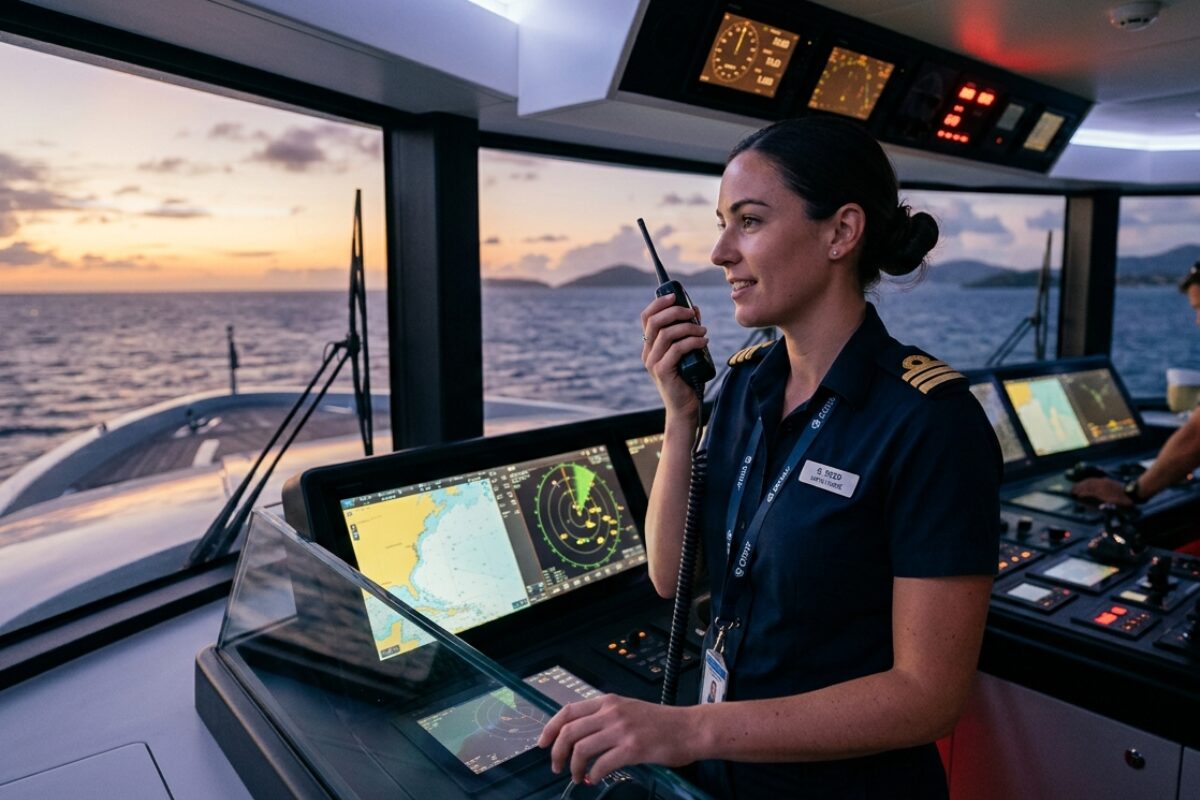
As Chief Mate (First Officer), you become the captain’s second-in-command. This role balances bridge navigation with overall vessel operational management, safety oversight, and deck department leadership.
What Operational and Administrative Duties Define the Chief Mate Position?
The Chief Mate oversees the day-to-day operations of the yacht, acting as the operational bridge between the captain, the department heads, and the deck crew.
Primary duties include managing comprehensive vessel maintenance programs, calculating stability and trim for safe passage planning, and overseeing onboard Safety Management Systems (SMS).
The Chief Mate leads emergency safety drills, maintains life-saving equipment, supports wider vessel operations, manages port state compliance documentation, and oversees crew welfare across the vessel.
How Do You Log Effective Bridge Watch Hours Under a Captain’s Supervision?
Advancing to Chief Mate usually sits within a typical 5 to 10 year progression from deckhand to captain, and it requires logging active, high-quality watchkeeping hours on the bridge while keeping qualifications current and building real passage-making experience.
You must spend extended periods navigating routes under the direct oversight and guidance of the master.
For STCW revalidation, officers with 360 days or more of sea time in the last five years may complete a refresher, while those short of that threshold may need a basic training refresher course, basic training refresher, or STCW basic training refresher as part of basic training revalidation or an STCW refresher path, and many schools group these as refresher courses.
Handling complex coastal entries, night watches through heavy commercial traffic lanes, and navigating in severe weather builds the tactical judgment needed for command.
This period allows you to refine your passage planning, bridge team management, electronic navigation, and weather routing skills under expert mentorship.
Step 6 – What Does It Take to Earn Your Master 3000 GT Ticket and Become Captain?
Reaching the rank of Master 3000 GT represents the pinnacle of the superyacht qualification pathway. As captain, you take full command of the vessel, its crew, guests, and operational budget.
What Advanced Modules Are Needed for Final Master Certification?
To earn your Master 3000 GT Certificate of Competency (CoC), you must complete advanced command-level training modules:
- Seamanship and Commercial Management: Master shipmaster business, charter party agreements, international maritime law, insurance, and flag state regulations.
- Advanced Navigation and Meteorology: Develop high-level passage planning skills, ocean passage analysis, and complex weather routing strategies.
- Command-Level Safety and Stability: Study advanced damage control, ship stability in extreme weather conditions, high-level crisis management protocols, fire prevention, and survival craft proficiency as part of command-level emergency preparedness.
Advanced and refresher STCW courses are often needed throughout command-track progression to maintain compliance with training requirements, including STCW basic training courses.
After completing these written modules and logging the required sea time as a qualified officer, you sit for your final Master command oral examination.
How Do You Shift Your Mindset from Operational Officer to Superyacht Captain?
Stepping into the role of captain requires a fundamental shift in mindset. You move from managing daily physical or operational tasks to accepting total legal, financial, environmental, and human responsibility for the vessel, including compliance, crew personal safety, and emergency decision-making.
A superyacht captain must balance owner and guest relations with strict adherence to maritime laws, Port State Control inspections, and safety management protocols. High-stress emergency leadership, diplomatic communication, crew retention, and sound financial budgeting become just as important as your navigation expertise on the bridge.
How Does Structured Maritime Training Accelerate Your Path to the Bridge?
Progressing through the ranks requires careful long-term planning. Balancing busy seasonal charter schedules with mandatory study requirements is one of the biggest challenges ambitious crew members face throughout their careers.
Why Is Strategic Planning of Study Leave Critical for Steady Career Growth?
To maintain steady career momentum, you must plan your study leave blocks and schedule mandatory STCW courses around work rotations and seasonal employment cycles. Scheduling training module attendance during Mediterranean or Caribbean refit periods prevents you from losing out on active charter tips, monthly salary, or valuable sea time opportunities.
When evaluating maritime academies, look at the overall STCW course price and package inclusions to maximize your budget. Training in top maritime hubs offers high-quality instruction at competitive rates.
Comparing the STCW course price Cape Town options reveals that South Africa remains one of the most affordable regions globally to complete MCA-recognized certifications.
Working with an accredited maritime training institution means it should deliver approved basic training course options and later refresher training that meet recognized standards. Clear training requirements also help you complete prerequisite tickets efficiently, preventing costly career delays.
Frequently Asked Questions
How long does the career progression from deckhand to captain usually take?
Moving from an entry-level deckhand to a fully certified Master 3000 GT typically takes between 8 and 12 years. The timeline depends on your ability to log active sea service, secure study leave, and pass written and oral examinations.
What STCW basic training certifications do I need to start as a deckhand?
New deckhands must complete STCW Basic Safety Training, Designated Security Duties (DSD), and hold a valid ENG1 medical fitness certificate before seeking employment aboard a yacht. STCW is the Standards of Training, Certification and Watchkeeping convention and is required for yacht crew working beyond U.S. waters.
Its four basic safety skills modules are personal survival techniques, basic firefighting, elementary first aid, and First Aid & CPR, and personal safety and social responsibilities.
How do I log sea time to advance my yacht officer rank?
Sea time must be logged in an official seafarer discharge book or service log, supported by formal sea service testimonials signed by the vessel’s captain after every contract or season.
What is the difference between Officer of the Watch (OOW) and Chief Mate?
An Officer of the Watch handles bridge navigation watches and routine deck operations. The Chief Mate serves as second-in-command, managing vessel stability, safety management systems, exterior maintenance, and department leadership.
Do I need advanced mathematical skills to pass bridge officer exams?
While advanced higher mathematics is not required, you must be comfortable with practical navigation math, algebra, chart plotting formulas, tidal calculations, and stability geometry, all of which are covered during training courses.
Can I complete my officer training modules and basic training refresher while working full-time on a yacht?
You log required sea time while working full-time aboard, but some STCW courses combine classroom instruction with practical drills, so officers usually need planned study leave at accredited maritime academies even when employed full-time. Students should also expect physically active elements in safety modules rather than purely academic study.
Conclusion
The career progression from deckhand to captain is one of the most structured and satisfying pathways in the maritime industry. By combining hands-on deck experience with meticulous sea time logging, targeted study modules, and professional mentorship, you can steadily advance from washing hulls on the aft deck to commanding a vessel from the bridge.
Success requires dedication, long-term focus, and a commitment to mastering seamanship at every single rank along the way.
Ready to take your first step or advance to your next bridge ticket? Partner with Certified Training to map out your personalized maritime career path.
Whether you need entry-level deck credentials or officer preparation modules, speak with Certified Training’s maritime career advisors today or explore our full suite of accredited superyacht career training courses to fast-track your route to command.