

There’s a particular kind of tension that shows up when the horizon simply… vanishes. One minute we’re navigating by familiar shapes and clear references, and the next we’re staring into a grey wall where distance and speed feel oddly distorted.
In those moments, “we’ll just keep a sharp lookout” is still true, but it’s also incomplete, because our eyes can only do so much.
That’s where the RYA Radar Course steps in with calm, practical confidence. It teaches us how to turn a screen full of blips, arcs, and clutter into a coherent picture of what’s actually happening around the yacht.
More importantly, it helps us make better decisions earlier, when we still have time, space, and options.
What is the RYA Radar Course?
The RYA Radar Course by Certified Training is a focused, hands-on programme designed to build real competence with marine radar for navigation and collision avoidance. The course is aimed at users of radar in small craft, especially those seeking to improve their radar skills for safer boating.
Radar is an essential navigation aid and collision avoidance aid on small craft, playing a crucial role in safe navigation. Rather than treating radar like a fancy accessory, the course frames it as a working safety tool, something we actively interpret and use to make choices under pressure.
By the end, we’re not just “able to operate the unit”; we’re able to think with it.
It’s also worth clearing up what the course isn’t. Radar training is not the same thing as a general navigation course, and it doesn’t replace the COLREGs.
Navigation courses help us plan and execute passages; COLREGs teach us the rules of the road; radar training teaches us how to build situational awareness when visibility collapses, and the world stops being obvious.
International regulations, such as the International Regulations for the Prevention of Collisions at Sea, require that if radar is carried, operators must know how to use it.
Who should take the RYA Radar Course?
If we’re responsible for a watch or moving toward that level of responsibility, radar competence quickly stops being optional. The RYA radar course is aimed at both leisure and commercial skippers operating small craft, including motorboats and sailing yachts.
The course is designed for users of radar in small craft, reflecting the fact that radar is becoming increasingly common on small craft as the price of equipment falls. It is a strong fit for yacht skippers and captains who want cleaner decision-making, as well as watchkeepers and deck crew who want to be genuinely useful when conditions turn unfriendly.
It’s equally relevant for leisure sailors who may only occasionally run in reduced visibility but want a better safety margin when they do.
In practice, the people who benefit most are those who already understand that “confidence” isn’t a vibe, it’s a skill. Radar becomes most valuable at night, in fog, in heavy rain, and in busy traffic lanes where everything feels closer than it should.
The skills and knowledge obtained from the course are essential for effective radar use. Training helps us avoid the trap of reacting late or reacting to the wrong target entirely.
Why radar training is essential for yacht safety
Radar is one of those tools that quietly prevents problems right up until the moment it’s misunderstood. Radar is a key tool for the prevention of collisions at sea, and proper knowledge of all the functions is necessary to ensure the radar functions correctly.
A poorly tuned radar can create clutter that looks like traffic, hide targets inside noise, or encourage us to trust a picture that isn’t accurate enough for the decisions we’re making. The biggest risks tend to come from false confidence, not from a lack of equipment.
Without solid radar skills, a few predictable issues show up again and again. Inexperienced users can be easily misled by radar displays, which is why training is crucial.
Collisions in fog or heavy rain become more likely because visual lookout is limited and distances feel compressed. Targets get misinterpreted, movement gets misunderstood, and the bridge team can end up reacting late, or worse, making a confident decision based on a misread display.
Radar training also helps us break the habit of leaning too hard on GPS and AIS. AIS is useful, but it isn’t universal, it isn’t always configured correctly, and it doesn’t represent every target we’ll encounter.
International regulations, such as Rule 19 and Rule 5 of the COLREGS, require proper use of radar for collision prevention. Radar, used well, gives us a direct read on returns and relative movement, exactly the information we need to stay ahead of risk.
Radar is also an essential skill for those wishing to achieve the RYA Coastal Skipper or Yachtmaster qualification.
What does the RYA Radar Course cover?
The RYA radar course syllabus is designed to move us from “turn it on and hope” to “interpret, verify, decide” in a structured way. This one-day course provides a clear understanding of radar and how it can be used to aid navigation and avoid collisions.
It is designed to provide knowledge of all the functions of a versatile radar system, enabling students to use radar effectively for navigation and collision avoidance. It starts with the principles, how radar works, and what we’re actually seeing, then quickly shifts into the practical reality of tuning, interpreting targets, and using radar for collision avoidance.
Many training centres deliver this through classroom teaching supported by simulator-based scenarios, because radar competence is built through repetition and realistic problem-solving.
The syllabus includes:
- Understanding all the functions of a radar system
- Practical use of radar for navigation and collision avoidance
- Radar pilotage and its importance for safe navigation
- Tuning and interpreting radar targets
- Limitations and proper interpretation of radar as a versatile electronic navigation aid
Students are provided with course materials, including a workbook and plotting sheets.
The syllabus breakdown (what we’ll actually learn)
- Principles of marine radar: how radar measures distance and bearing, and why echoes look the way they do.
- Radar controls and tuning: gain, sea clutter, rain clutter, and how incorrect tuning creates misleading pictures.
- Range, bearing, and target identification: reading what matters quickly and consistently, even on a busy screen.
- Radar plotting and collision avoidance: understanding relative motion and what early collision risk looks like.
- Use of EBLs and VRMs: measuring bearings and ranges accurately so decisions aren’t guesswork.
- Radar pilotage: using radar to determine your vessel’s position and course, assisting with safe navigation, fixing positions, and collision avoidance.
- Radar limitations and errors: blind sectors, shadowing, false echoes, and why land returns can be deceptive.
- Radar use in restricted visibility: building a steady scan routine and staying ahead of the situation.
- Integration with AIS, GPS, and chartplotters: using overlays intelligently without becoming dependent on them.
This is why the course translates so well to real watchkeeping. It doesn’t just explain features; it teaches judgment. And judgment is what keeps us out of the accident report, and out of the “we were sure it was fine” post-mortem.
Practical skills taught in the course
The most valuable part of RYA radar training safe is that it’s designed to live in the real world, not in a manual. We learn how to interpret radar displays in realistic scenarios, including messy ones where clutter, land returns, and moving targets overlap.
That “messy middle” is exactly what reduced visibility looks like in practice, and training helps us stay calm inside it. Understanding how sea state affects radar returns is also emphasized, as interpreting signals accurately in different sea conditions is crucial for safe navigation.
We also learn how to track both moving and stationary targets without relying on instinct alone.
A key part of this is understanding how our own course and speed affect what we see, and how quickly a developing situation can tighten if we don’t verify movement early. The course builds a repeatable process: observe, measure, confirm, and then decide.
Plotting is another cornerstone skill, whether manual plotting logic or electronic plotting tools. Radar is used to fix position and assist with pilotage, helping us identify hazards and navigate safely, especially in restricted visibility.
Even when modern systems provide target tracking assistance, the underlying thinking still matters, because it keeps us from trusting a flawed output or misreading a vector. Add in a strong understanding of sea returns, rain clutter, and interference, and radar becomes far less intimidating and far more useful.
Participants have praised the excellent teaching and practical exercises provided during the RYA Radar course, noting that many had previously tried using radar without much success before taking the course.
Small craft considerations: unique challenges and solutions
Operating radar on small craft, whether a nimble sailing yacht or a compact motorboat, comes with its own set of challenges.
Unlike larger vessels, small craft often have lower radar antenna heights, more limited power, and less space for equipment, all of which can affect how well the radar functions and how easily targets are detected.
Add in the realities of restricted visibility, busy coastal waters, and the need for quick, confident decisions, and it’s clear why specialized radar training is so valuable.
The RYA Radar course is tailored to these realities. It equips students with the skills to interpret radar returns accurately, even when the picture is cluttered or confusing.
Understanding target definition, knowing what a real vessel looks like on the screen versus a buoy, a rain squall, or a patch of land, is a core part of the training. The course also covers the use of radar reflectors, which are especially important for small craft to ensure they are visible to other vessels’ radar systems, enhancing safety and compliance with international regulations.
For those working toward the RYA Yachtmaster Offshore or already holding the RYA Yachtmaster qualification, mastering radar is not just a box to tick; it’s a critical skill for navigation and collision avoidance.
The course dives into the different types of radar display, helping students understand which features affect the radar picture and how to adjust them for best results. By focusing on practical operation, the RYA Radar course enables small craft operators to avoid collisions, navigate confidently in restricted visibility, and operate within the rules of the sea.
For anyone serious about sailing or skippering a yacht, this training is highly recommended, not just for passing exams, but for real-world safety and competence.
Small craft radar systems: what you need to know
Getting the most out of a small craft radar system starts with a basic understanding of how the radar set works and what its controls actually do. The RYA Radar course breaks down the operation of radar systems into clear, manageable steps, making it accessible even for those new to electronic navigation aids.
Students learn how to switch on the radar, adjust key settings like gain, range, and sea clutter, and refine the radar picture so that it provides reliable information for navigation and collision avoidance.
A major focus of the course is radar plotting, using the radar display to track the movement of other vessels and assess collision risk. This skill is essential for small craft, where quick decisions can make all the difference in busy or restricted waters.
The course also covers the integration of radar with other electronic navigation aids, such as GPS and AIS, and explains the role of radar reflectors in making your own vessel more visible to others.
Understanding the limitations of small craft radar is just as important as knowing its strengths. The RYA Radar course teaches students how to interpret the display in different sea states, recognize when the radar picture might be misleading, and make the necessary adjustments to get the best results.
By the end of this one-day course, students have a comprehensive overview of radar systems, from basic operation to advanced techniques for avoiding collisions.
Whether you’re preparing for a passage, aiming for a Yachtmaster certificate, or simply want to enhance your navigation skills, this training ensures you know how to use your radar set with confidence and competence on the open sea.
Course format, duration, and assessment
Most training centres run the course as a one-day programme, commonly delivered in a classroom setting supported by simulator exercises. So if we’re asking about RYA radar course duration, the typical answer is simple: it’s usually completed in a single day.
The structure is designed to be intensive and practical, with enough scenario repetition to build confidence quickly.
Assessment is usually practical and continuous rather than a big formal exam. In plain language, we’re evaluated while we work through exercises, demonstrate understanding of controls, and make safe decisions in scenarios.
On successful completion, we receive an RYA radar certificate, which acts as proof of training and a solid addition alongside other RYA certification courses.
RYA Radar Course online vs classroom
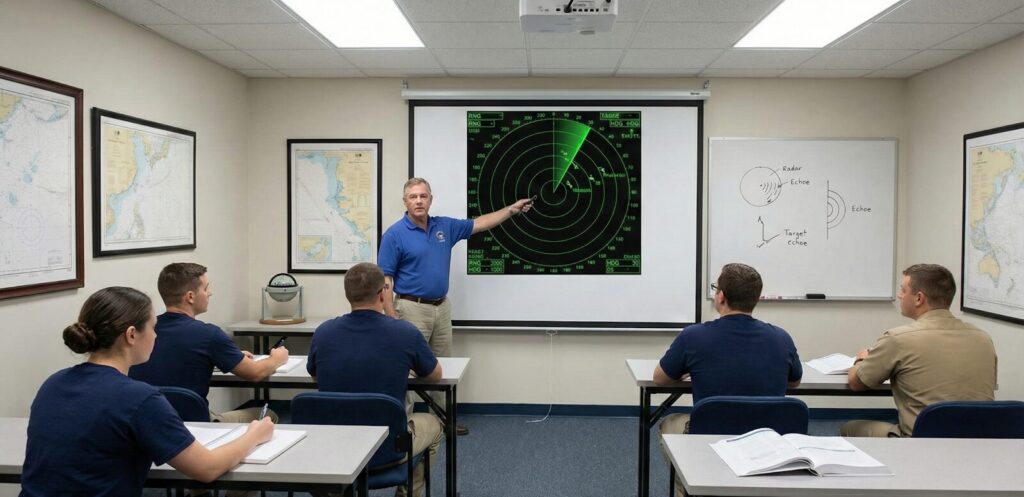
Let’s be honest: radar is a skill, not a lecture topic. That’s why RYA radar course online options can be useful for theory and familiarisation, but they rarely replace the value of instructor-led scenario work, especially for people who are new, nervous, or stepping into watchkeeping responsibilities.
Reading about tuning helps; tuning while the picture is messy, targets are moving, and you need to decide? That’s the real test.
Online learning shines when we want to understand terms, controls, and the basics of marine navigation radar before stepping into practical training. It can reduce the learning curve and make simulator time far more productive.
Classroom training, however, is where we build decision-making: instructors correct interpretation errors in real time, challenge assumptions, and help us develop a consistent scan-and-verify routine that holds up under pressure.
A simple way to choose is this: if we’re building competence for real watchkeeping, in-person training with simulator access is usually the best value. If we already have experience and want a refresher or extra reps, online learning can be a smart supplement. Either way, the goal stays the same: practice until interpretation becomes reliable.
Is the RYA Radar Course mandatory?
In many cases, radar training is strongly recommended rather than strictly mandatory as a standalone legal requirement. That said, good seamanship expects that if radar is onboard and in use, the people operating it understand what it can and cannot do. The risk isn’t having radar; the risk is using it with misplaced confidence.
Where the course can become “effectively mandatory” is through operational expectations.
Commercial endorsements, charter operations, yacht management policies, and insurance requirements often push crews toward formal competence even if there’s no single universal law that says “you must.” In real life, it’s often a best-practice standard that keeps us employable, insurable, and safe.
How the RYA Radar Course supports professional progression
On a CV, the RYA radar certificate signals something valuable: we’ve trained for reduced visibility and collision-avoidance decision-making, not just fair-weather day runs.
Captains and managers don’t want passengers on the bridge team; they want people who can contribute on watch, report targets clearly, and keep the situation under control when conditions deteriorate.
Operationally, radar training tends to build confidence quickly because it replaces guessing with a process. We get faster at confirming targets, measuring movement, and communicating what we see in a way the team can act on.
That confidence then flows into better bridge communication, cleaner helm decisions, and stronger watchkeeping competence, especially at night and in challenging weather.
RYA radar course cost: what to expect
The uncomfortable truth about RYA radar course cost is that it varies widely by training centre, location, and what’s included. Some providers publish a “from” price, while others bundle course packs, manuals, simulator access, and admin fees differently. That’s why comparing prices without comparing inclusions often leads to disappointment.
The smarter way to evaluate cost is to look at value: how much simulator time is included, how experienced the instructors are, and whether the course is structured around realistic scenarios.
Cheap training that doesn’t build usable confidence isn’t a bargain; it’s a delay. If we’re investing in safety and competence, we want training that actually changes how we perform on watch.
Common mistakes radar training helps prevent
Most radar mistakes don’t come from not knowing which button to press. They come from misreading the story the screen is telling, then making a confident decision on a flawed assumption.
Radar is a crucial navigation aid and electronic navigation aid, and having proper knowledge is essential for the prevention of navigation errors and collisions at sea. In reduced visibility, small errors compound quickly because we lose the luxury of visual confirmation.
Classic radar traps
- Misreading echoes and shadows: assuming a blank area is clear water when it may be shadowed.
- Confusing land clutter with vessels: treating coastline returns like traffic, or missing traffic inside clutter.
- Incorrect collision-avoidance decisions: altering course too late, or altering in a way that increases risk.
- Overconfidence in electronic aids: trusting overlays and GPS positioning while ignoring raw radar returns.
Radar training helps us build disciplined habits: scan consistently, verify with tools like EBL/VRM, and avoid one-look conclusions. It’s “boring” in the most professional way, because boring on watch usually means safe.
How to get the most out of your radar training for yachts
If we want the course to stick, we should treat it like a skill bootcamp rather than a lecture day.
A light refresher on navigation terms and collision-reg thinking before the course can help, because it reduces the cognitive load and frees us to focus on interpretation and decision-making. The more prepared we are, the more useful every scenario becomes.
During training, our best move is to ask “why” constantly. Why does that return stretch? Why did the target jump? Why does the picture change when we touch the screen? Why is that CPA trend concerning? Those answers form the mental model we’ll rely on later when the conditions are noisy and the pace is high.
After the course, we should practice on real equipment as soon as possible. Even thirty minutes of calm-water tuning and target identification locks in the learning and makes the radar picture feel familiar. When reduced visibility shows up again, as it always does, we’ll be operating from competence, not hope.
Conclusion: Radar confidence is earned, not assumed
When visibility drops, we don’t get extra time to think; we get less. That’s why the RYA Radar Course is such a practical win: it builds a repeatable process we can trust when the screen is busy, the weather is messy, and the stakes are high.
We learn how to tune properly, interpret targets correctly, and make earlier, safer decisions instead of reactive ones.
Whether we’re aiming for sharper watchkeeping, a stronger CV, or simply more comfortable night passages, marine radar training pays back quickly. The real value isn’t the certificate on paper; it’s the calm that shows up on the bridge when conditions stop being friendly. And in yachting, that calm is the difference between “we handled it” and “we got lucky.”